
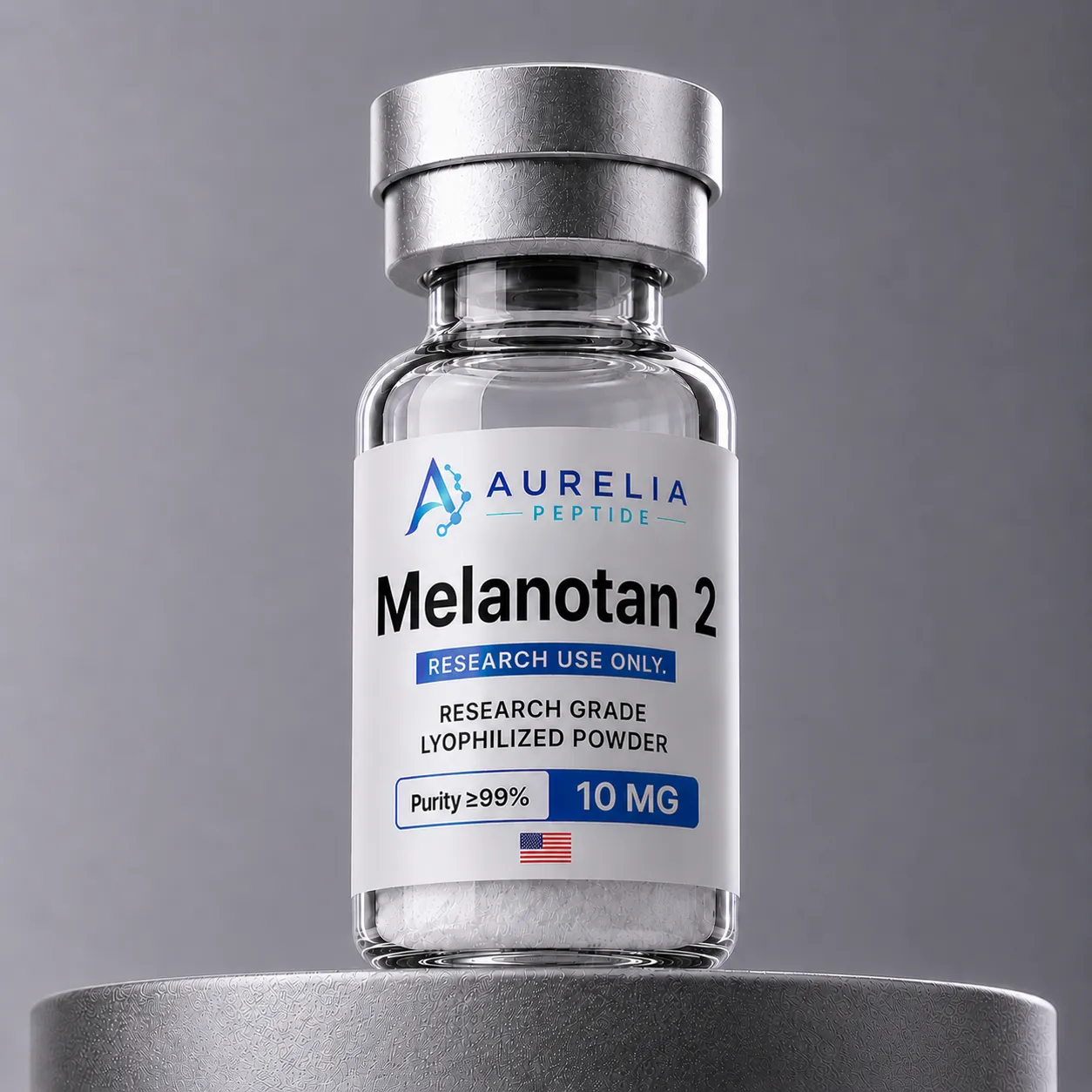
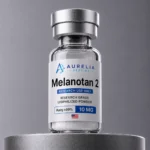

Melanotan II
A cyclic melanocortin analog studied in pigmentation, receptor pharmacology and central melanocortin signaling
- Fulfillment Origin
- us
Melanotan II is a synthetic cyclic heptapeptide analog of alpha-melanocyte-stimulating hormone. Research has examined its activity across several melanocortin receptor subtypes, including MC1R-linked pigmentation pathways and MC3R/MC4R-linked central signaling. This dossier summarizes compound-level research and is intended only for laboratory reference.
Synthetic cyclic heptapeptide · melanocortin receptor agonist
- Formula
- C50H69N15O9
- Molecular weight
- 1024.18 g/mol
- Form
- Lyophilized powder
- CAS / ID
- 121062-08-6
Independently tested. Verifiably pure.
Every batch of Melanotan II is reviewed against its independent laboratory documentation before fulfillment.
- HPLC Purity AnalysisReported purity: Lot-specific purity — see COA
- Mass SpectrometryMass-spectrometric identity — see lot COA
- Heavy Metals ScreeningLot-specific result — see COA
- Endotoxins (LPS)Lot-specific result — see COA
- Sterility TestingLot-specific result — see COA
- Net Peptide ContentLot-specific result — see COA
- HPLC Purity
- Lot-specific purity — see COA
- Identity
- Mass-spectrometric identity — see lot COA
- Endotoxin (LAL)
- Lot-specific result — see COA
- Lab
- Independent third-party laboratory
Not for human or veterinary use. For in-vitro laboratory research only. This product is not intended to diagnose, treat, cure, or prevent any disease.
A cyclic seven-residue analog of alpha-MSH.
Melanotan II uses a constrained cyclic peptide scaffold and a D-phenylalanine substitution to produce a potent melanocortin-receptor research ligand.
Cyclic heptapeptide
A seven-residue peptide with an intramolecular ring structure.
Ac-Nle-cyclo[Asp-His-D-Phe-Arg-Trp-Lys]-NH2
A compact alpha-MSH-derived melanocortin analog.
Pan-melanocortin signaling
Published work has focused on MC1R, MC3R, MC4R and MC5R pharmacology.
The Melanotan II molecule visualized.
The animated structure illustrates the compound's cyclic seven-residue framework and elemental composition.
Published research areas associated with Melanotan II.
The summaries below reflect receptor-pharmacology and preclinical literature themes and are not instructions for administration or use.
Melanogenesis research
MC1R activation has been studied in melanocyte signaling and eumelanin-production models.
Energy-balance and arousal pathways
MC4R-linked hypothalamic pathways are a major focus in appetite and arousal research.
Broad melanocortin pharmacology
Melanotan II is generally used as a nonselective melanocortin-system research probe.
Melanocortin signaling pathways visualized.
The animated map separates pigmentation, central metabolic and broader receptor-pharmacology research themes.
Pigmentation signaling
MC1R activation can stimulate adenylyl cyclase, cAMP and downstream melanogenesis pathways in research models.
Central appetite and arousal signaling
MC4R-linked circuits are studied in energy balance, food-intake regulation and arousal-associated pathways.
Broader melanocortin pharmacology
Activity at additional receptor subtypes supports comparative receptor and structure-activity research.
How Melanotan II differs from PT-141.
Both are cyclic melanocortin peptides, but Melanotan II is generally used as a broader melanocortin agonist, while PT-141 was developed with reduced emphasis on MC1R-linked pigmentation.
Broad melanocortin profile
Commonly associated with MC1R, MC3R, MC4R and MC5R research.
More centrally focused profile
Developed from the Melanotan II scaffold for central melanocortin research.
Pigmentation pathway activity
Melanotan II retains strong MC1R-related pigmentation research relevance.
| Compound | Primary research emphasis | Receptor profile | Molecular type |
|---|---|---|---|
| Melanotan II | Pigmentation and broad melanocortin signaling | Broad MC receptor activity | Cyclic heptapeptide |
| PT-141 / Bremelanotide | Central arousal-pathway research | More centrally focused melanocortin profile | Cyclic heptapeptide |
Receptor research profile visualized.
These bars summarize the relative emphasis of receptor systems discussed in the literature and are not binding-affinity measurements.
Exposure is formulation- and route-dependent.
Published pharmacokinetic observations depend on formulation, route, species and study design. A universal half-life should not be assigned to lyophilized research material.
More constrained than linear alpha-MSH
The cyclic structure is used to improve conformational stability in receptor research.
Do not generalize across formulations
Published exposure data may not transfer between experimental preparations.
Use analytical documentation
Identity and net peptide content should be verified using the actual batch COA.
Full specification.
The fields below describe the compound identity. Final analytical values must match the actual Aurelia lot documentation.
Melanotan II
Synthetic cyclic melanocortin analog.
Ac-Nle-cyclo[Asp-His-D-Phe-Arg-Trp-Lys]-NH2
Seven amino-acid residues.
C50H69N15O9
Elemental composition of Melanotan II.
1024.18 g/mol
Calculated molecular mass.
121062-08-6
Common Melanotan II identifier.
See lot COA
Confirm identity, purity, net peptide content and applicable contaminant testing.
From receptor engagement to downstream signaling.
This is an illustrative mechanistic sequence, not a dosing or treatment timeline.
Melanocortin receptor engagement
Melanotan II interacts with several melanocortin receptor subtypes.
G-protein signaling
Receptor activation can stimulate intracellular cAMP-linked pathways.
Pathway-specific response
MC1R, MC3R, MC4R and MC5R produce different downstream research endpoints.
Experimental measurement
Researchers evaluate pigmentation, food-intake, arousal and receptor-signaling outcomes.
Handle as a sensitive cyclic peptide.
Follow supplier-validated storage documentation for the supplied lot and record all preparation conditions.
Cold, dry and protected
Minimize moisture, heat, direct light and repeated temperature cycling.
Matrix and time matter
Working stability depends on solvent, concentration, pH, container and temperature.
Track lot and hold time
Document preparation time, storage temperature and elapsed time before analysis.
- Record the batchLink each experiment to the vial lot and its corresponding COA.
- Minimize cyclingAvoid unnecessary freeze-thaw or warming cycles.
- Use validated containersSelect materials appropriate for low-concentration peptide solutions.
- Document preparationRecord solvent, concentration, pH, temperature and hold time.
For in-vitro laboratory research only. Not for human or veterinary use.
Melanotan II literature library.
The publications below provide context for pigmentation, central melanocortin and receptor-pharmacology research.
Foundational receptor and structure-activity research involving synthetic melanocortin analogs.
View primary source →Early human research evaluating pigmentation-related and physiological responses.
View primary source →Preclinical work examining melanocortin pathways in feeding and energy-balance regulation.
View primary source →Clinical research contributing to the understanding of melanocortin-linked arousal pathways.
View primary source →References.
Independent literature supporting the molecular and mechanistic context used in this dossier.
- Sawyer TK et al. Melanocortins and melanocortin receptors. Adv Exp Med Biol. 1993.Open source ↗
- Dorr RT et al. Melanotan-II, a potent melanotropin and erectogenic agent. Peptides. 1996.Open source ↗
- Fan W et al. Role of melanocortinergic neurons in feeding and the agouti obesity syndrome. Nature. 1997.Open source ↗
- Wessells H et al. Synthetic melanotropic peptide initiates erections in men with psychogenic erectile dysfunction. Urology. 1998.Open source ↗
Related products
GHK-Cu