

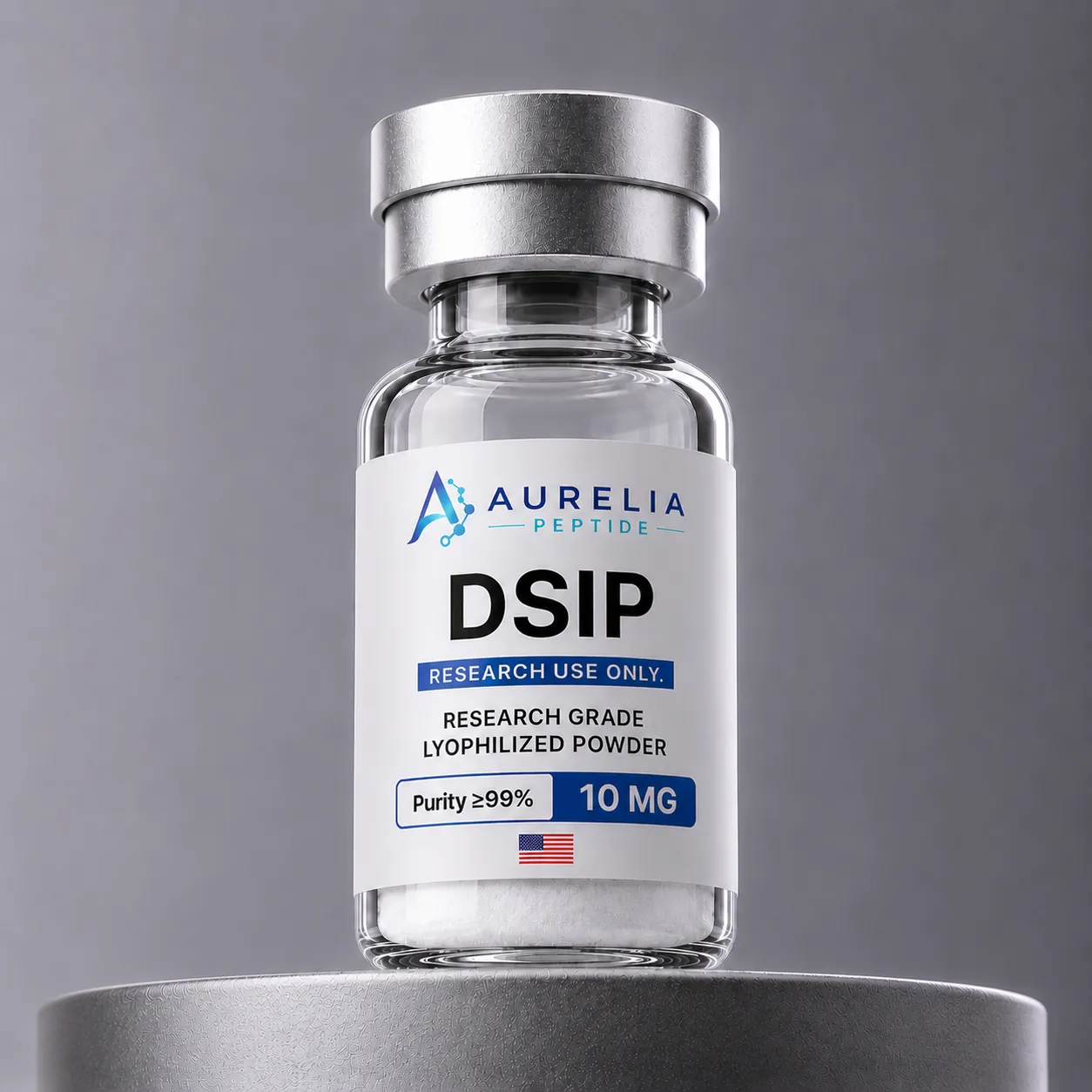
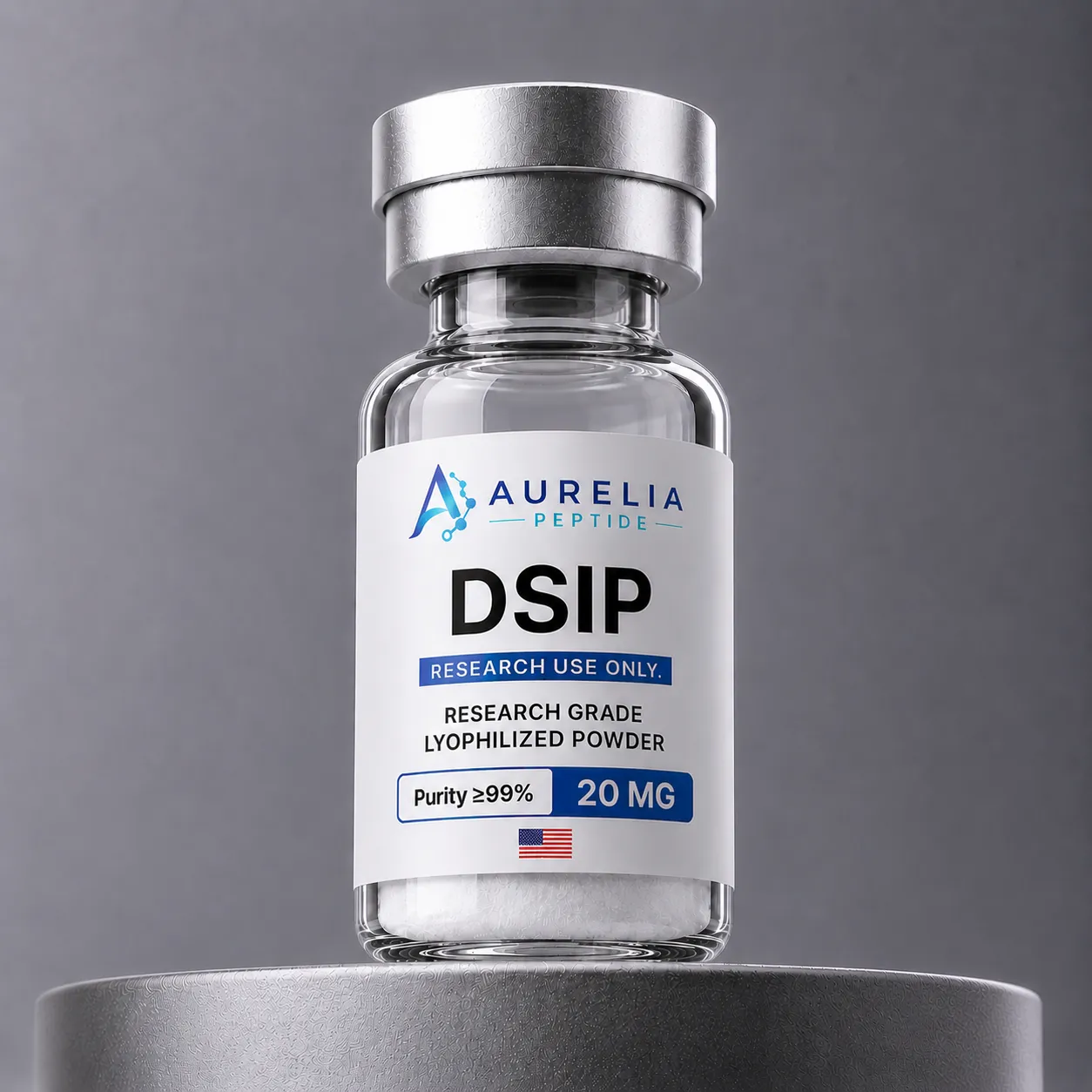
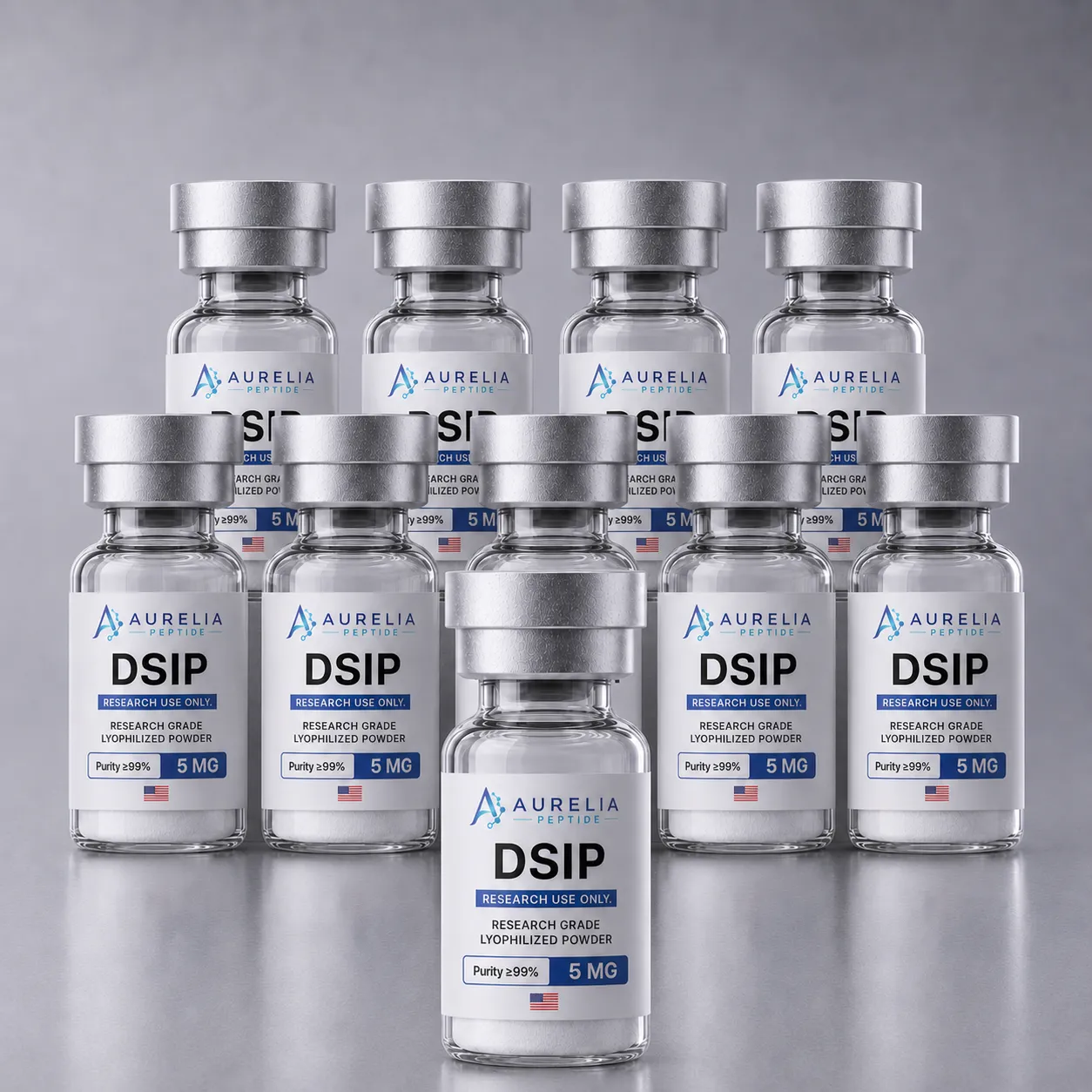
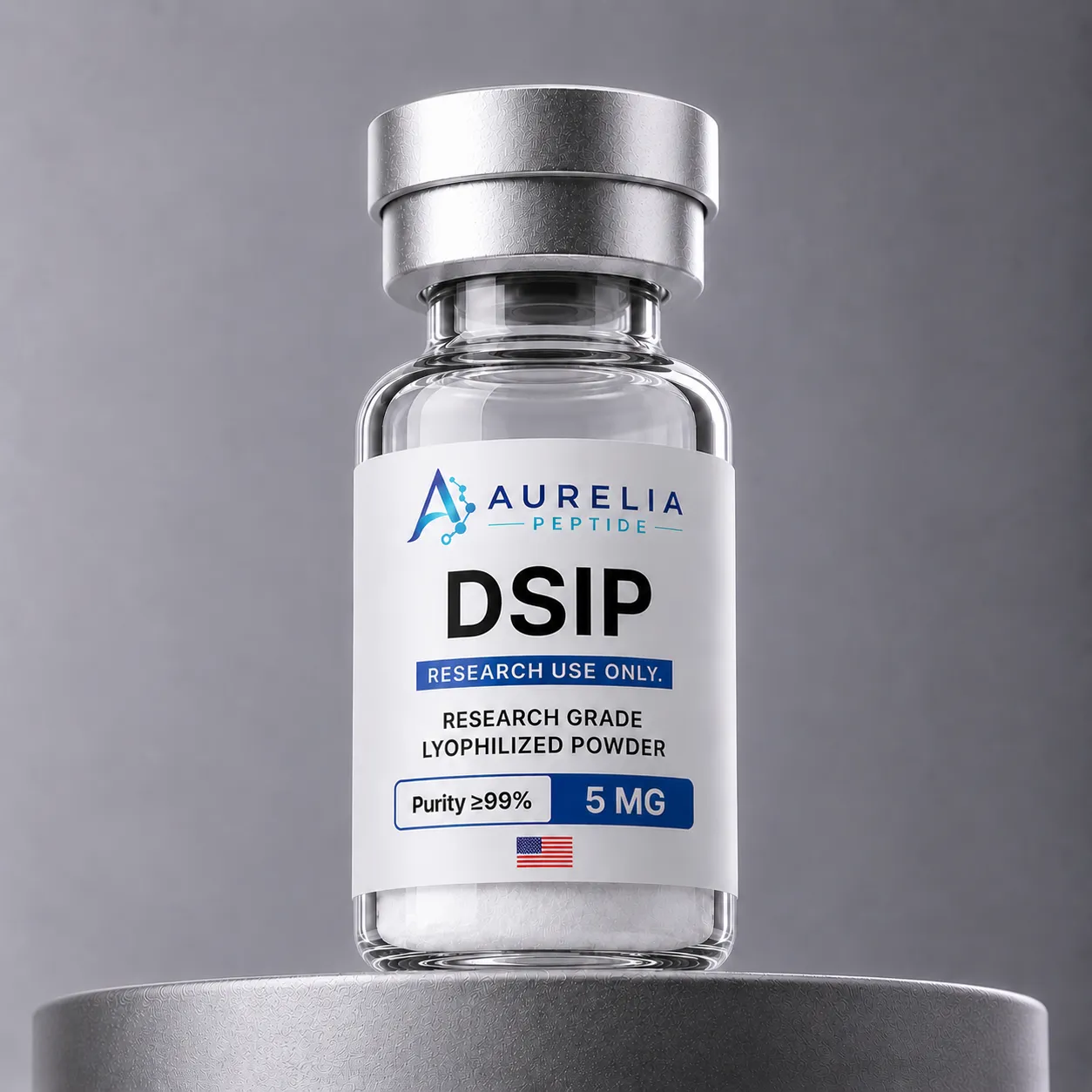
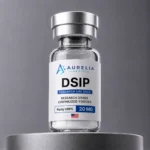
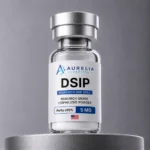
DSIP
A nine-residue neuropeptide studied in sleep architecture, circadian biology and stress-response research
- Fulfillment Origin
- us
Delta Sleep-Inducing Peptide, commonly abbreviated DSIP, is a synthetic nonapeptide with the sequence Trp-Ala-Gly-Gly-Asp-Ala-Ser-Gly-Glu. It was originally investigated after experiments associated it with delta-wave sleep. Later work explored sleep architecture, circadian regulation, neuroendocrine signaling and stress responses. Published findings are mixed, and no definitive endogenous precursor, receptor or universally accepted mechanism has been established.
Synthetic nonapeptide · Sleep and neuroendocrine research peptide
- Formula
- C35H48N10O15
- Molecular weight
- 848.81 g/mol
- Form
- Lyophilized powder
- CAS / ID
- 62568-57-4
Independently tested. Verifiably pure.
Every batch of DSIP is reviewed against its independent laboratory documentation before fulfillment.
- HPLC Purity AnalysisReported purity: Lot-specific purity — see COA
- Mass SpectrometryMass-spectrometric identity — see lot COA
- Heavy Metals ScreeningLot-specific result — see COA
- Endotoxins (LPS)Lot-specific result — see COA
- Sterility TestingLot-specific result — see COA
- Net Peptide ContentLot-specific result — see COA
- HPLC Purity
- Lot-specific purity — see COA
- Identity
- Mass-spectrometric identity — see lot COA
- Endotoxin (LAL)
- Lot-specific result — see COA
- Lab
- Independent third-party laboratory
Not for human or veterinary use. For in-vitro laboratory research only. This product is not intended to diagnose, treat, cure, or prevent any disease.
A compact nonapeptide linked to early delta-wave sleep research.
DSIP contains nine amino acids arranged in the sequence WAGGDASGE. Its small size and acidic C-terminal region made it an early candidate for studying humoral regulation of sleep, although its endogenous identity and receptor biology remain unresolved.
Synthetic nonapeptide
A linear nine-residue peptide also known as emideltide.
Delta-wave sleep
Named after early rabbit experiments reporting increased spindle and delta EEG activity.
Mechanistically unresolved
No universally accepted receptor, precursor gene or single signaling pathway has been confirmed.
The DSIP molecule visualized.
The animated model represents the WAGGDASGE peptide backbone and its carbon, hydrogen, nitrogen and oxygen composition.
Published research areas associated with DSIP.
The summaries below describe historical and experimental research themes. The literature is heterogeneous, and reported sleep effects have not been consistently reproduced.
Slow-wave and sleep-latency research
Some animal and small human studies reported changes in sleep latency, sleep efficiency or slow-wave sleep.
Sleep-wake and daytime-function research
Several studies examined overnight sleep together with alertness, performance and next-day function.
Neuroendocrine stress-response research
DSIP has been studied in relation to ACTH, cortisol, monoamines and stress-associated physiological changes.
DSIP research pathways visualized.
Because no definitive receptor has been identified, the pathway map presents major research hypotheses rather than a confirmed linear mechanism.
Sleep-state modulation
Early experiments associated DSIP exposure with changes in delta activity, sleep latency and sleep continuity.
Sleep-wake regulation
Research has examined interactions with hypothalamic and circadian control systems.
Stress-axis signaling
Some studies evaluated DSIP as a modifier of corticotropin and glucocorticoid responses, with inconsistent findings.
Neurochemical modulation
Animal work has explored serotonin, monoamine oxidase activity and other neurotransmitter-related endpoints.
How DSIP differs from melatonin.
Both appear in sleep-related research, but they differ substantially in molecular class, biological certainty and proposed mechanism.
Experimental sleep-related nonapeptide
A nine-residue peptide with no confirmed receptor or precursor gene.
Established circadian hormone
An indoleamine produced by the pineal gland with characterized MT1 and MT2 receptors.
Exploratory versus established signaling
DSIP remains mechanistically uncertain, while melatonin has a defined endocrine and receptor framework.
| Compound | Molecular class | Primary research area | Mechanistic certainty |
|---|---|---|---|
| DSIP | Nine-residue peptide | Sleep architecture and stress response | Unresolved |
| Melatonin | Indoleamine hormone | Circadian timing and sleep onset | Established MT1 / MT2 signaling |
Research emphasis visualized.
These bars summarize the literature focus and do not represent quantitative receptor-binding data.
A small peptide with limited standardized pharmacokinetic data.
DSIP is a low-molecular-weight nonapeptide, but standardized human pharmacokinetic parameters are not well established. Published studies generally emphasize physiological outcomes rather than validated concentration-time profiles.
Compact peptide structure
Its nine-residue sequence is substantially smaller than many endocrine and growth-factor peptides.
No universal half-life value
Kinetic estimates depend on analytical method, matrix, formulation and experimental design.
Effects do not map cleanly to exposure
Some historical studies reported delayed sleep-related effects, while others found weak, absent or paradoxical responses.
Full specification.
The fields below describe compound identity. Final analytical values must match the actual Aurelia lot documentation.
Delta Sleep-Inducing Peptide
Also known as DSIP or emideltide.
Synthetic nonapeptide
Linear peptide containing nine amino-acid residues.
Trp-Ala-Gly-Gly-Asp-Ala-Ser-Gly-Glu
One-letter abbreviation: WAGGDASGE.
9 residues
A compact neuropeptide research sequence.
C35H48N10O15
Elemental composition of the free peptide.
848.81 g/mol
Calculated molecular mass.
62568-57-4
Common DSIP identifier.
See lot COA
Confirm identity, purity, net content, sterility and endotoxin results.
Salt forms, hydrates or counterions can change the reported formula and molecular weight; use the actual lot documentation.
From peptide exposure to sleep-research endpoints.
This is an illustrative research sequence, not a dosing or treatment timeline.
Peptide exposure
DSIP is introduced into the experimental model under defined conditions.
Central and neuroendocrine interaction
The study measures hypothalamic, neurochemical or stress-axis responses.
EEG and sleep-state assessment
Researchers evaluate delta activity, sleep latency, efficiency and stage distribution.
Circadian and functional outcomes
Daytime alertness, performance, stress markers or behavioral endpoints are compared.
Handle as a sensitive research peptide.
Use storage conditions validated for the actual Aurelia lot and document all preparation and hold-time variables.
Cold, dry and protected
Protect from moisture, direct light, excessive heat and repeated temperature cycling.
Solution stability is conditional
Stability depends on solvent, pH, concentration, container, temperature and contamination control.
Minimize adsorption and degradation
Use validated low-binding containers and avoid unnecessary agitation.
- Record the lotLink every experiment to the vial identifier and corresponding COA.
- Follow validated storageUse the temperature range stated on the Aurelia label and lot documentation.
- Minimize cyclingAvoid repeated warming, cooling or freeze-thaw events.
- Document preparationRecord solvent, concentration, pH, container, temperature and elapsed hold time.
For in-vitro laboratory research only. Not for human or veterinary use.
DSIP literature library.
The publications below provide historical context for sleep, circadian, neuroendocrine and stress-related research. Findings are mixed and should not be presented as settled clinical conclusions.
An early review of DSIP isolation, molecular identity and reported sleep-related effects.
View primary source →A critical review emphasizing the uncertain endogenous identity, receptor biology and sleep-factor hypothesis.
View primary source →A controlled human sleep study reporting delayed and variable changes in sleep regulation.
View primary source →A placebo-controlled study reporting modest changes in sleep efficiency and latency, with weak overall effects.
View primary source →Research examining nighttime sleep together with daytime alertness and performance.
View primary source →Animal research investigating stress-associated monoamine oxidase and serotonin changes.
View primary source →References.
Independent literature supporting the molecular and research context used in this dossier.
- Graf MV, Kastin AJ. Delta-sleep-inducing peptide: a review. Neuroscience & Biobehavioral Reviews. 1984.Open source ↗
- Kovalzon VM, Strekalova TV. Delta sleep-inducing peptide: a still unresolved riddle. 2006.Open source ↗
- Schneider-Helmert D. The influence of synthetic DSIP on sleep in humans. 1981.Open source ↗
- Bes F et al. Effects of delta sleep-inducing peptide on sleep of chronic insomniac patients. 1992.Open source ↗
- Schneider-Helmert D. Effects of delta-sleep-inducing peptide on 24-hour sleep-wake function. 1987.Open source ↗
- Khvatova EM et al. Effects of DSIP and related compounds on stress-induced monoamine changes. 1995.Open source ↗