
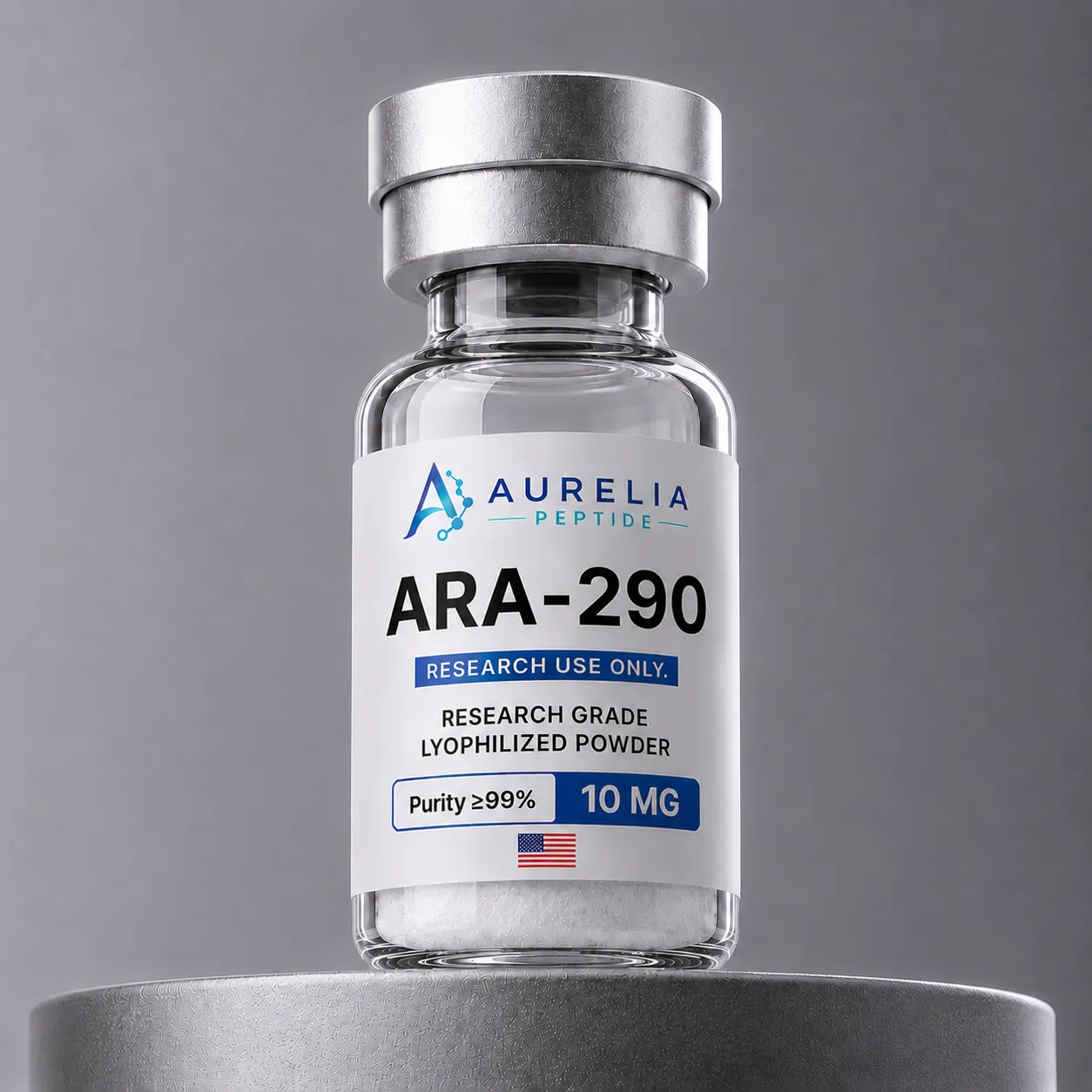
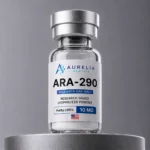
ARA-290
An EPO helix-B-derived 11-residue peptide studied for innate repair receptor signaling
- Fulfillment Origin
- us
ARA-290, also known as cibinetide, is an 11-amino-acid peptide derived from the helix-B surface of erythropoietin. It was designed to activate the innate repair receptor formed by EPOR and the beta-common receptor CD131 while avoiding classical erythropoietic signaling. Research commonly examines inflammatory resolution, tissue-protective pathways, small-fiber nerve biology and neuropathic pain models.
EPO helix-B-derived peptide · Innate repair receptor agonist
- Formula
- C55H89N19O20
- Molecular weight
- 1257.3 g/mol
- Form
- Lyophilized powder
- CAS / ID
- 1208243-50-8
Independently tested. Verifiably pure.
Every batch of ARA-290 is reviewed against its independent laboratory documentation before fulfillment.
- HPLC Purity AnalysisReported purity: Lot-specific purity — see COA
- Mass SpectrometryMass-spectrometric identity — see lot COA
- Heavy Metals ScreeningLot-specific result — see COA
- Endotoxins (LPS)Lot-specific result — see COA
- Sterility TestingLot-specific result — see COA
- Net Peptide ContentLot-specific result — see COA
- HPLC Purity
- Lot-specific purity — see COA
- Identity
- Mass-spectrometric identity — see lot COA
- Endotoxin (LAL)
- Lot-specific result — see COA
- Lab
- Independent third-party laboratory
Not for human or veterinary use. For in-vitro laboratory research only. This product is not intended to diagnose, treat, cure, or prevent any disease.
An 11-residue peptide engineered from erythropoietin's tissue-protective surface.
ARA-290 reproduces a small functional region from the helix-B surface of erythropoietin. Its sequence is designed to engage the innate repair receptor without activating the classical receptor pathway responsible for red-blood-cell production.
EPO-derived undecapeptide
A linear 11-amino-acid peptide commonly known as cibinetide.
EPOR / CD131 innate repair receptor
Selectively studied at the heteromeric tissue-protective receptor rather than the erythropoietic EPOR homodimer.
Inflammation and nerve repair
Used to investigate cytoprotection, inflammatory resolution and small-fiber regeneration.
The ARA-290 molecule visualized.
The animated model represents the 11-residue peptide backbone and its elemental composition.
Published research areas associated with ARA-290.
The summaries below describe experimental and clinical research themes and are not directions for administration or clinical use.
Innate repair receptor signaling
ARA-290 is studied as a selective agonist of the heteromeric tissue-protective receptor.
Reduced pro-inflammatory signaling
Research models examine cytokine modulation, microglial activity and macrophage phenotype.
Peripheral nerve-fiber recovery
Clinical and preclinical studies have investigated changes in corneal and cutaneous small-nerve-fiber density.
ARA-290 signaling pathways visualized.
The animated pathway map follows innate repair receptor activation through JAK2/STAT3, PI3K/Akt and anti-apoptotic signaling.
Innate repair receptor activation
ARA-290 engages the heteromeric EPOR and beta-common receptor complex.
Protective transcriptional signaling
Receptor activation can recruit JAK2 and STAT3 pathways associated with tissue-protective responses.
Cell-survival support
PI3K/Akt signaling is studied in relation to cytoprotection and reduced apoptotic stress.
Inflammatory resolution
Research examines reduced microglial activation and suppression of pro-inflammatory signaling.
How ARA-290 differs from erythropoietin.
ARA-290 reproduces the tissue-protective surface of EPO without providing the full glycoprotein architecture required for classical erythropoietic signaling.
Innate repair receptor agonist
Targets EPOR/CD131 tissue-protective signaling and is designed to avoid hematopoietic activity.
Full glycoprotein hormone
Engages classical EPOR homodimers and drives erythroid-cell development.
Repair signaling without erythropoiesis
The central research rationale is separation of cytoprotection from red-blood-cell stimulation.
| Compound | Molecular class | Primary receptor context | Red-cell effect |
|---|---|---|---|
| ARA-290 | 11-residue peptide | EPOR / CD131 innate repair receptor | Not targeted |
| Erythropoietin | Glycoprotein hormone | Classical EPOR homodimer and repair receptor | Strong erythropoietic activity |
Receptor and pathway selectivity visualized.
These bars summarize the intended research profile and are not universal quantitative binding-affinity measurements.
Very short plasma exposure with longer biological signaling.
ARA-290 is reported to have an extremely short plasma half-life, while downstream tissue-protective effects in research models may persist for many hours or days.
Rapid systemic clearance
Direct peptide exposure is brief and depends on assay design and study conditions.
Signaling can outlast exposure
Receptor-triggered cytoprotective and inflammatory-resolution pathways may remain active after plasma levels decline.
Use analytical documentation
Identity, purity and net peptide content should be verified using the actual Aurelia lot COA.
Full specification.
The fields below describe compound identity. Final analytical values must match the actual Aurelia lot documentation.
ARA-290 (Cibinetide)
Synthetic EPO helix-B surface-derived peptide.
Undecapeptide
Linear 11-amino-acid tissue-protective peptide.
EPOR / CD131 innate repair receptor
Heteromeric receptor associated with tissue-protective signaling.
pGlu-Glu-Gln-Leu-Glu-Arg-Ala-Leu-Asn-Ser-Ser
Eleven-residue peptide sequence.
C55H89N19O20
Elemental composition of ARA-290.
1257.3 g/mol
Calculated molecular mass.
1208243-50-8
Common ARA-290 identifier.
See lot COA
Confirm identity, purity, net content, sterility and endotoxin results.
From innate repair receptor binding to tissue-protective signaling.
This is an illustrative mechanistic sequence, not a dosing or treatment timeline.
EPOR / CD131 engagement
ARA-290 binds the innate repair receptor complex.
JAK2 / STAT3 activation
The receptor recruits intracellular signaling linked to protective gene expression.
PI3K / Akt and anti-apoptotic signaling
Cell-survival pathways support resistance to inflammatory and metabolic stress.
Inflammatory resolution and repair
Downstream changes may reduce microglial activation and support nerve-fiber recovery.
Handle as a sensitive research peptide.
Use the storage conditions validated for the actual Aurelia lot and document all preparation and hold-time variables.
Cold, dry and protected
Protect from moisture, direct light, excessive heat and repeated temperature cycling.
Solution stability is conditional
Stability depends on solvent, pH, concentration, container, temperature and contamination control.
Avoid repeated freeze-thaw events
Aliquoting and validated low-binding containers may reduce degradation and adsorption.
- Record the lotLink every experiment to the vial identifier and corresponding COA.
- Follow validated storageUse the temperature range stated on the Aurelia label and lot documentation.
- Minimize agitationHandle gently to reduce foaming, adsorption and peptide degradation.
- Document preparationRecord solvent, concentration, pH, container, temperature and elapsed hold time.
For in-vitro laboratory research only. Not for human or veterinary use.
ARA-290 literature library.
The publications below provide context for innate repair receptor pharmacology, small-fiber neuropathy and neuropathic pain models.
Foundational work describing EPO-derived peptides that preserve tissue-protective activity without erythropoiesis.
View primary source →A randomized pilot study evaluating neuropathic symptoms and physical-function outcomes.
View primary source →Clinical research examining symptom changes and small-nerve-fiber regrowth markers.
View primary source →Preclinical work linking prolonged allodynia reduction with suppression of spinal microglial responses.
View primary source →References.
Independent literature supporting the molecular and mechanistic context used in this dossier.
- Brines M et al. Nonerythropoietic, tissue-protective peptides derived from the tertiary structure of erythropoietin. 2008.Open source ↗
- Heij L et al. Safety and efficacy of ARA 290 in sarcoidosis patients with symptoms of small fiber neuropathy: a randomized, double-blind pilot study. 2012.Open source ↗
- Dahan A et al. ARA 290 improves symptoms in patients with sarcoidosis-associated small nerve fiber loss and increases corneal nerve fiber density. 2013.Open source ↗
- Swartjes M et al. ARA 290 produces long-term relief of neuropathic pain coupled with suppression of the spinal microglia response. 2014.Open source ↗
Related products
BPC-157
Glow
KLOW Blend