
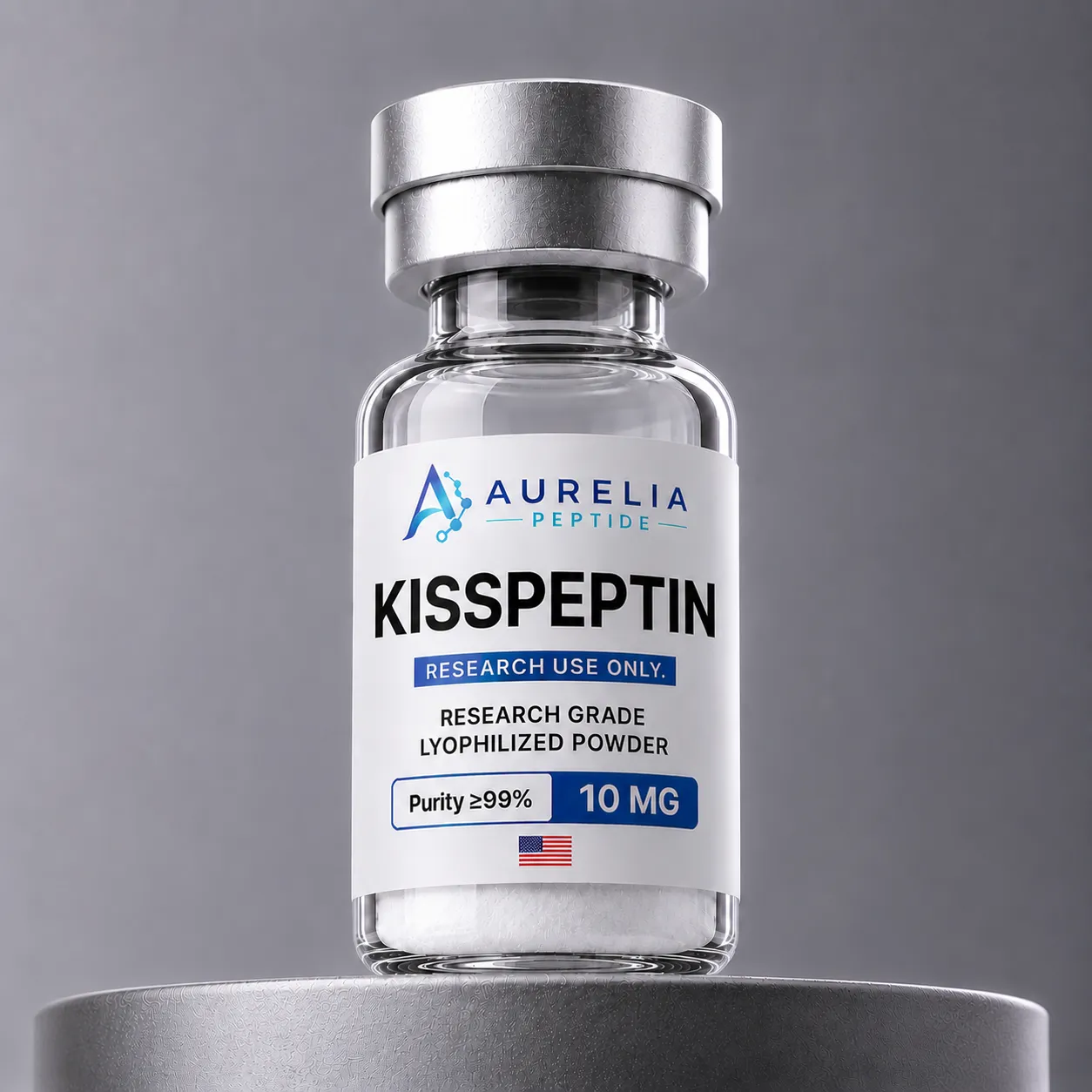
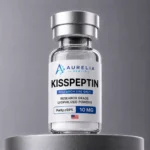


Kisspeptin
A KISS1-derived decapeptide studied as an upstream regulator of the reproductive neuroendocrine axis
- Fulfillment Origin
- us
Kisspeptin-10 is the conserved C-terminal decapeptide of the human KISS1-derived kisspeptin family. It binds the G-protein-coupled receptor KISS1R, formerly known as GPR54, and activates hypothalamic signaling upstream of gonadotropin-releasing hormone. Research commonly examines puberty, GnRH pulse generation, luteinizing-hormone and follicle-stimulating-hormone responses, reproductive neuroendocrinology and interactions between reproductive and metabolic signaling.
KISS1-derived decapeptide · KISS1R/GPR54 agonist
- Formula
- C63H83N17O14
- Molecular weight
- 1302.4 g/mol
- Form
- Lyophilized powder
- CAS / ID
- 374675-21-5
Independently tested. Verifiably pure.
Every batch of Kisspeptin is reviewed against its independent laboratory documentation before fulfillment.
- HPLC Purity AnalysisReported purity: Lot-specific purity — see COA
- Mass SpectrometryMass-spectrometric identity — see lot COA
- Heavy Metals ScreeningLot-specific result — see COA
- Endotoxins (LPS)Lot-specific result — see COA
- Sterility TestingLot-specific result — see COA
- Net Peptide ContentLot-specific result — see COA
- HPLC Purity
- Lot-specific purity — see COA
- Identity
- Mass-spectrometric identity — see lot COA
- Endotoxin (LAL)
- Lot-specific result — see COA
- Lab
- Independent third-party laboratory
Not for human or veterinary use. For in-vitro laboratory research only. This product is not intended to diagnose, treat, cure, or prevent any disease.
Ten amino acids that activate a central reproductive signaling receptor.
Human Kisspeptin-10 corresponds to residues 45–54 of metastin and contains the sequence Tyr-Asn-Trp-Asn-Ser-Phe-Gly-Leu-Arg-Phe-NH2. This amidated C-terminal sequence retains strong KISS1R activity and is widely used in experimental studies of the hypothalamic-pituitary-gonadal axis.
Amidated decapeptide
A ten-residue KISS1-derived peptide representing the receptor-active C-terminal region.
KISS1R / GPR54
A Gq/11-coupled receptor expressed in reproductive neuroendocrine and other tissues.
GnRH and gonadotropin signaling
Used to investigate upstream control of GnRH, LH and FSH secretion.
The Kisspeptin-10 molecule visualized.
The animated model represents the amidated human decapeptide backbone and the conserved receptor-binding C-terminal motif.
Published research areas associated with Kisspeptin.
The summaries below describe experimental and clinical research themes and are not directions for administration or claims of clinical outcome.
Upstream reproductive-axis activation
KISS1R activation on GnRH neurons can increase gonadotropin-releasing-hormone output.
Gonadotropin research
GnRH signaling can produce downstream luteinizing-hormone and follicle-stimulating-hormone responses.
Pulse-generation research
Kisspeptin neurons interact with neurokinin B and dynorphin networks involved in GnRH pulse generation.
Research outcomes depend strongly on peptide fragment, exposure pattern, sex-steroid environment, developmental stage and experimental model.
Kisspeptin signaling pathways visualized.
The animated pathway map follows KISS1R activation through Gq/11, phospholipase C and calcium signaling to GnRH and gonadotropin responses.
Receptor engagement
Kisspeptin-10 binds the KISS1R G-protein-coupled receptor.
Phospholipase-C activation
Gq/11 signaling promotes PIP2 hydrolysis and formation of IP3 and DAG.
Neuronal excitation
Intracellular calcium and protein-kinase-C signaling increase GnRH-neuron activity.
Gonadotropin signaling
GnRH acts at the anterior pituitary to regulate luteinizing and follicle-stimulating hormone secretion.
How Kisspeptin differs from GnRH.
Kisspeptin and GnRH participate in the same reproductive axis but act at different levels of the signaling hierarchy.
Upstream hypothalamic regulator
Activates KISS1R on or near GnRH neurons and integrates hormonal, developmental and metabolic signals.
Pituitary-releasing hormone
Acts directly on pituitary gonadotrophs to control LH and FSH release.
KISS1R before GnRH receptor
Kisspeptin operates upstream of the classical pituitary GnRH receptor pathway.
| Compound | Primary receptor | Principal site | Immediate downstream effect |
|---|---|---|---|
| Kisspeptin-10 | KISS1R / GPR54 | Hypothalamic reproductive network | GnRH-neuron activation |
| GnRH | GnRHR | Anterior pituitary | LH and FSH secretion |
Receptor and pathway emphasis visualized.
These bars summarize the established research profile and are not universal quantitative binding-affinity measurements.
A rapidly cleared peptide with immediate neuroendocrine signaling.
Kisspeptin-10 is a short amidated peptide and is generally associated with brief direct exposure. Pharmacokinetic values vary with assay, formulation and experimental design, and should not be generalized across Kisspeptin-10 and Kisspeptin-54.
Compact receptor-active fragment
The conserved C-terminal decapeptide is sufficient for strong KISS1R activation.
Rapid peptide clearance
Short Kisspeptin fragments generally show shorter exposure than Kisspeptin-54.
Hormonal responses can outlast plasma exposure
Downstream GnRH and pituitary responses may persist after direct peptide concentration declines.
Do not assign Kisspeptin-54 pharmacokinetic values to a Kisspeptin-10 product.
Full specification.
The fields below describe human Kisspeptin-10. Final analytical values must match the actual Aurelia lot documentation.
Human Kisspeptin-10
The receptor-active C-terminal decapeptide of human metastin.
Amidated neuropeptide
Synthetic ten-amino-acid KISS1R ligand.
Tyr-Asn-Trp-Asn-Ser-Phe-Gly-Leu-Arg-Phe-NH2
Human metastin residues 45–54.
10 residues
Conserved active C-terminal fragment.
C63H83N17O14
Elemental composition reported for human Kisspeptin-10.
1302.4 g/mol
Calculated molecular mass.
374675-21-5
Common human Kisspeptin-10 identifier.
See lot COA
Confirm fragment identity, amidation, purity, net content, sterility and endotoxin results.
Kisspeptin-10, Kisspeptin-13, Kisspeptin-14 and Kisspeptin-54 are distinct molecular products. The product label and COA must identify the supplied fragment.
From KISS1R binding to gonadotropin signaling.
This is an illustrative mechanistic sequence, not a dosing or treatment timeline.
KISS1R receptor binding
Kisspeptin-10 engages the GPR54/KISS1R receptor.
Gq / PLC signaling
PIP2 hydrolysis generates IP3 and DAG and increases intracellular calcium.
GnRH-neuron activation
The hypothalamic reproductive network increases GnRH release.
Pituitary LH and FSH response
GnRH stimulates gonadotrophs and produces downstream endocrine readouts.
Handle as a sensitive amidated research peptide.
Use storage conditions validated for the actual Aurelia lot and document all preparation and hold-time variables.
Cold, dry and protected
Protect from moisture, direct light, excessive heat and repeated temperature cycling.
Solution stability is conditional
Stability depends on solvent, pH, concentration, container, temperature and contamination control.
Preserve C-terminal amidation
Analytical identity should confirm the intended amidated fragment and exclude sequence or counterion ambiguity.
- Record the lotLink every experiment to the vial identifier and corresponding COA.
- Follow validated storageUse the temperature range stated on the Aurelia label and lot documentation.
- Minimize cyclingAvoid repeated warming, cooling or freeze-thaw events.
- Document preparationRecord solvent, concentration, pH, container, temperature and elapsed hold time.
For in-vitro laboratory research only. Not for human or veterinary use.
Kisspeptin literature library.
The publications below provide context for KISS1R signaling, GnRH regulation, puberty and human reproductive neuroendocrinology.
Foundational receptor-deorphanization research identifying KISS1-derived peptides as GPR54 ligands.
View primary source →Human genetic evidence demonstrating the essential role of KISS1R signaling in reproductive maturation.
View primary source →Research describing direct activation of GnRH neurons and gonadotropin secretion.
View primary source →Early human research demonstrating acute endocrine responses to kisspeptin exposure.
View primary source →A receptor-focused review covering KISS1R signaling, trafficking and reproductive-axis function.
View primary source →A review of how metabolic and hormonal signals converge on hypothalamic kisspeptin neurons.
View primary source →References.
Independent sources supporting the molecular, receptor and neuroendocrine context used in this dossier.
- Kotani M et al. The metastasis suppressor gene KiSS-1 encodes kisspeptins, the natural ligands of GPR54. Journal of Biological Chemistry. 2001.Open source ↗
- de Roux N et al. Hypogonadotropic hypogonadism due to loss of function of the KiSS1-derived peptide receptor GPR54. 2003.Open source ↗
- Smith JT et al. Regulation of the neuroendocrine reproductive axis by kisspeptin-GPR54 signaling. 2006.Open source ↗
- Franssen D et al. The Kisspeptin Receptor: A Key G-Protein-Coupled Receptor in Reproductive Biology. 2018.Open source ↗
- Xie Q et al. The Role of Kisspeptin in the Control of the Hypothalamic-Pituitary-Gonadal Axis and Reproduction. 2022.Open source ↗
- PubChem. Kisspeptin-10 compound record, CID 25240297.Open source ↗
Related products

HCG