
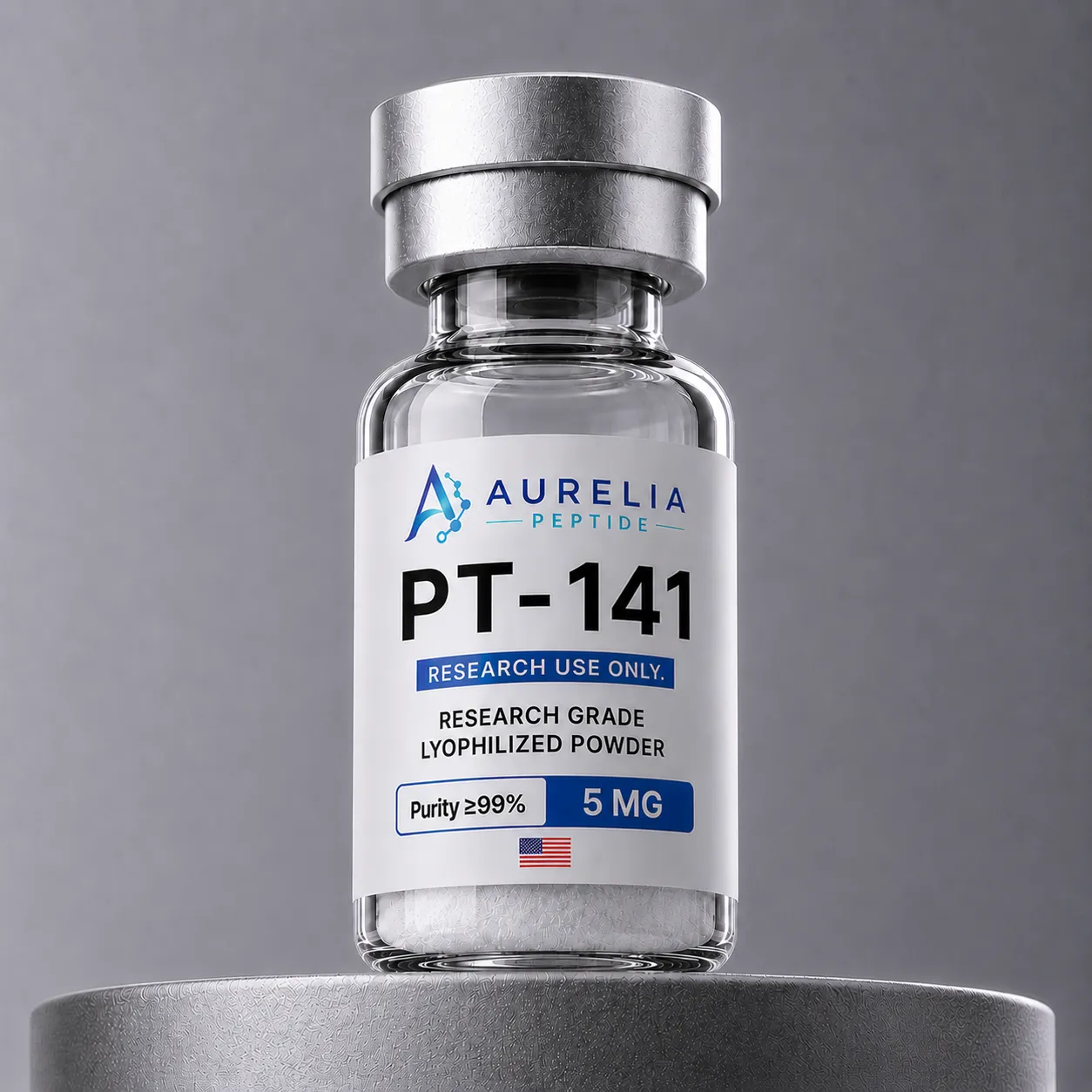
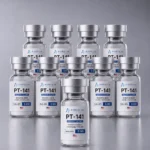
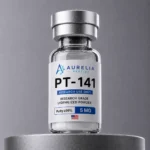
PT-141
A cyclic melanocortin peptide studied in central nervous system and receptor-signaling research
- Fulfillment Origin
- us
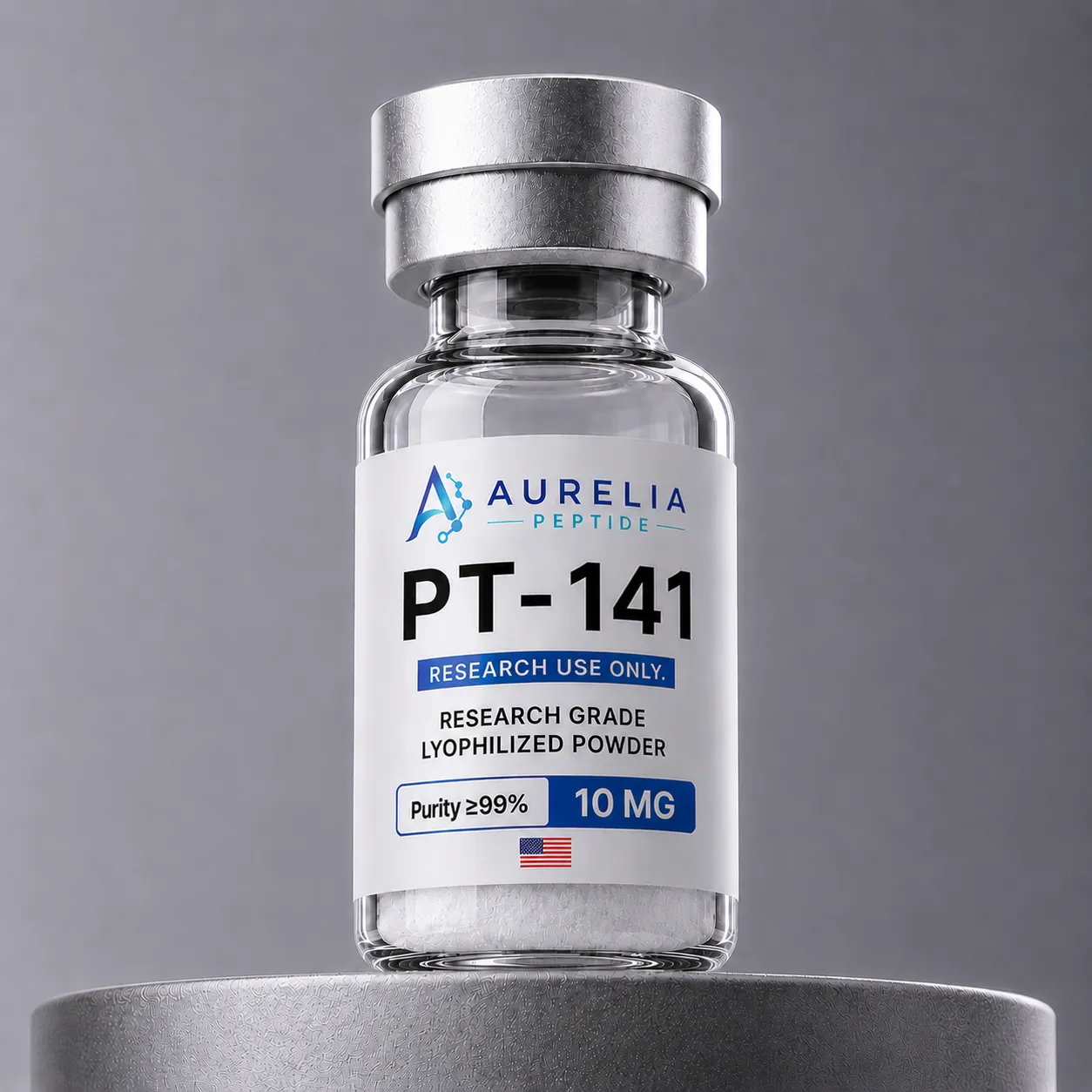
PT-141, also known as bremelanotide, is a synthetic cyclic heptapeptide analog of alpha-melanocyte-stimulating hormone. It activates multiple melanocortin receptor subtypes, with MC1R and MC4R among the most relevant documented targets. Research has focused on central melanocortin signaling, sexual-arousal pathways, pigmentation biology and receptor pharmacology. This page presents compound-level scientific information and is not intended as clinical guidance.
Synthetic cyclic heptapeptide · melanocortin receptor agonist
- Formula
- C50H68N14O10
- Molecular weight
- 1025.18 g/mol
- Form
- Lyophilized powder
- CAS / ID
- 189691-06-3
Independently tested. Verifiably pure.
Every batch of PT-141 is reviewed against its independent laboratory documentation before fulfillment.
- HPLC Purity AnalysisReported purity: Lot-specific purity — see COA
- Mass SpectrometryMass-spectrometric identity — see lot COA
- Heavy Metals ScreeningLot-specific result — see COA
- Endotoxins (LPS)Lot-specific result — see COA
- Sterility TestingLot-specific result — see COA
- Net Peptide ContentLot-specific result — see COA
- HPLC Purity
- Lot-specific purity — see COA
- Identity
- Mass-spectrometric identity — see lot COA
- Endotoxin (LAL)
- Lot-specific result — see COA
- Lab
- Independent third-party laboratory
Not for human or veterinary use. For in-vitro laboratory research only. This product is not intended to diagnose, treat, cure, or prevent any disease.
A cyclic melanocortin analog with central receptor activity.
Bremelanotide is a seven-residue cyclic peptide derived from the melanocortin scaffold. Its ring structure and amino-acid substitutions distinguish it from native alpha-MSH.
Cyclic heptapeptide
A seven-residue peptide with an intramolecular lactam ring.
Ac-Nle-cyclo-(Asp-His-D-Phe-Arg-Trp-Lys-OH)
A modified alpha-MSH-derived sequence designed to retain melanocortin-receptor activity.
Central melanocortin signaling
Research has emphasized MC4R-linked central nervous system pathways alongside broader melanocortin receptor pharmacology.
The PT-141 molecule visualized.
The animated model highlights the cyclic peptide backbone and the molecular composition of bremelanotide.
Published receptor and clinical-research observations.
The summaries below describe published bremelanotide research and receptor pharmacology. They should not be interpreted as instructions for use.
Central melanocortin signaling
MC4R is expressed across multiple central nervous system regions and is a key focus of bremelanotide mechanism research.
Nonselective melanocortin agonism
Bremelanotide activates several melanocortin receptor subtypes with different relative potencies.
FDA approval history
A prescription formulation of bremelanotide was approved in the United States in 2019 for a defined indication and population.
Melanocortin receptor signaling visualized.
The animated map separates central MC4R-linked signaling from MC1R-associated pigmentation biology and broader melanocortin receptor activity.
Central nervous system signaling
MC4R-expressing neurons are distributed across several CNS regions and are central to the compound's arousal-pathway research.
Pigmentation-associated signaling
MC1R activation is associated with melanocyte signaling and melanin expression.
Additional melanocortin pharmacology
Bremelanotide also interacts with other melanocortin receptor subtypes, though their relevance varies by model and endpoint.
How PT-141 differs from vascular-pathway compounds.
PT-141 is generally described as a centrally acting melanocortin agonist rather than a direct nitric-oxide or PDE5-pathway compound.
Central melanocortin pathways
The principal research focus is neural receptor signaling.
Cyclic peptide
PT-141 is structurally and mechanistically distinct from small-molecule vascular agents.
Neural rather than directly vascular
Published work emphasizes central arousal signaling rather than direct smooth-muscle PDE5 inhibition.
| Material class | Primary pathway | Molecular type | Research context |
|---|---|---|---|
| PT-141 / Bremelanotide | Melanocortin receptors | Cyclic heptapeptide | Central nervous system and arousal-pathway research |
| PDE5 inhibitor class | NO / cGMP pathway | Small molecule | Peripheral vascular signaling |
Receptor profile visualized.
The bars illustrate the relative emphasis of the receptor systems discussed in this dossier and are not binding-affinity values.
Exposure depends on formulation and route.
Published bremelanotide pharmacokinetics are formulation- and route-specific. Research material should not be assigned a universal half-life or exposure profile without validated data.
Documented in approved-product labeling
Human serum-protein binding has been reported for the approved formulation.
Formulation matters
Volume of distribution and systemic exposure depend on the administered formulation and route.
Do not infer finished-drug PK
Lyophilized research material should not inherit pharmacokinetic claims from a commercial finished drug.
Full specification.
The fields below describe the compound identity. Final purity, identity and content values must match the actual lot documentation.
Bremelanotide
Also known as PT-141.
Cyclic heptapeptide
Synthetic alpha-MSH analog.
C50H68N14O10
Free-base molecular formula.
1025.18 g/mol
Free-base molecular mass.
189691-06-3
Bremelanotide identifier.
See lot COA
Confirm identity, purity, peptide content and applicable contaminant testing.
From receptor binding to central signaling.
This is an illustrative mechanistic sequence, not a treatment or dosing timeline.
Melanocortin receptor engagement
Bremelanotide interacts with multiple melanocortin receptor subtypes.
MC4R-centered neural signaling
Central receptor activation is studied in hypothalamic and related neural circuits.
Downstream neuronal response
Neural signaling and behavioral endpoints are evaluated in preclinical and clinical research.
Receptor-specific outcomes
MC1R-associated pigmentation and other receptor-dependent responses are measured separately.
Handle as a sensitive cyclic peptide.
Use supplier-validated storage and preparation documentation for the supplied lot.
Cold, dry and protected
Minimize moisture, direct light and repeated temperature cycling.
Matrix and time matter
Working stability depends on solvent, concentration, container, pH and temperature.
Confirm acetate status
Bremelanotide free base and bremelanotide acetate should not be treated as analytically identical without documentation.
- Record the lotLink each experiment to the vial batch and corresponding COA.
- Verify molecular formConfirm free-base or acetate form before publishing identity data.
- Limit repeated cyclingAvoid unnecessary freeze-thaw or warming cycles.
- Document hold timeRecord preparation time, temperature and elapsed time before analysis.
For in-vitro laboratory research only. Not for human or veterinary use.
PT-141 literature library.
The studies below provide the scientific and clinical-development context for bremelanotide.
Early controlled research evaluating safety and physiological response following PT-141 administration.
View primary source →Clinical research examining safety, pharmacokinetics and erectile-response endpoints.
View primary source →Preliminary controlled research assessing desire and arousal-related outcomes.
View primary source →Phase 3 clinical-development publication evaluating efficacy and safety in a defined population.
View primary source →Review of central melanocortin pathways and proposed neural mechanisms.
View primary source →References.
Independent sources supporting the molecular and receptor-level scientific context used in this dossier.
- U.S. Food and Drug Administration. VYLEESI (bremelanotide injection) prescribing information. 2019.Open source ↗
- Diamond LE et al. Double-blind, placebo-controlled evaluation of PT-141 in healthy male subjects. Int J Impot Res. 2004.Open source ↗
- Rosen RC et al. Evaluation of the safety, pharmacokinetics and pharmacodynamic effects of PT-141. J Urol. 2004.Open source ↗
- Diamond LE et al. An effect on the subjective sexual response in premenopausal women receiving bremelanotide. J Sex Med. 2006.Open source ↗
- Kingsberg SA et al. Bremelanotide for the treatment of hypoactive sexual desire disorder. Obstet Gynecol. 2019.Open source ↗
- Pfaus JG. The neurobiology of bremelanotide for the treatment of hypoactive sexual desire disorder in premenopausal women. J Sex Med. 2022.Open source ↗
Related products
HCG