
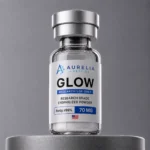
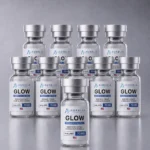
Glow
A three-component research blend combining copper-peptide, pentadecapeptide and actin-associated pathways
- Fulfillment Origin
- us
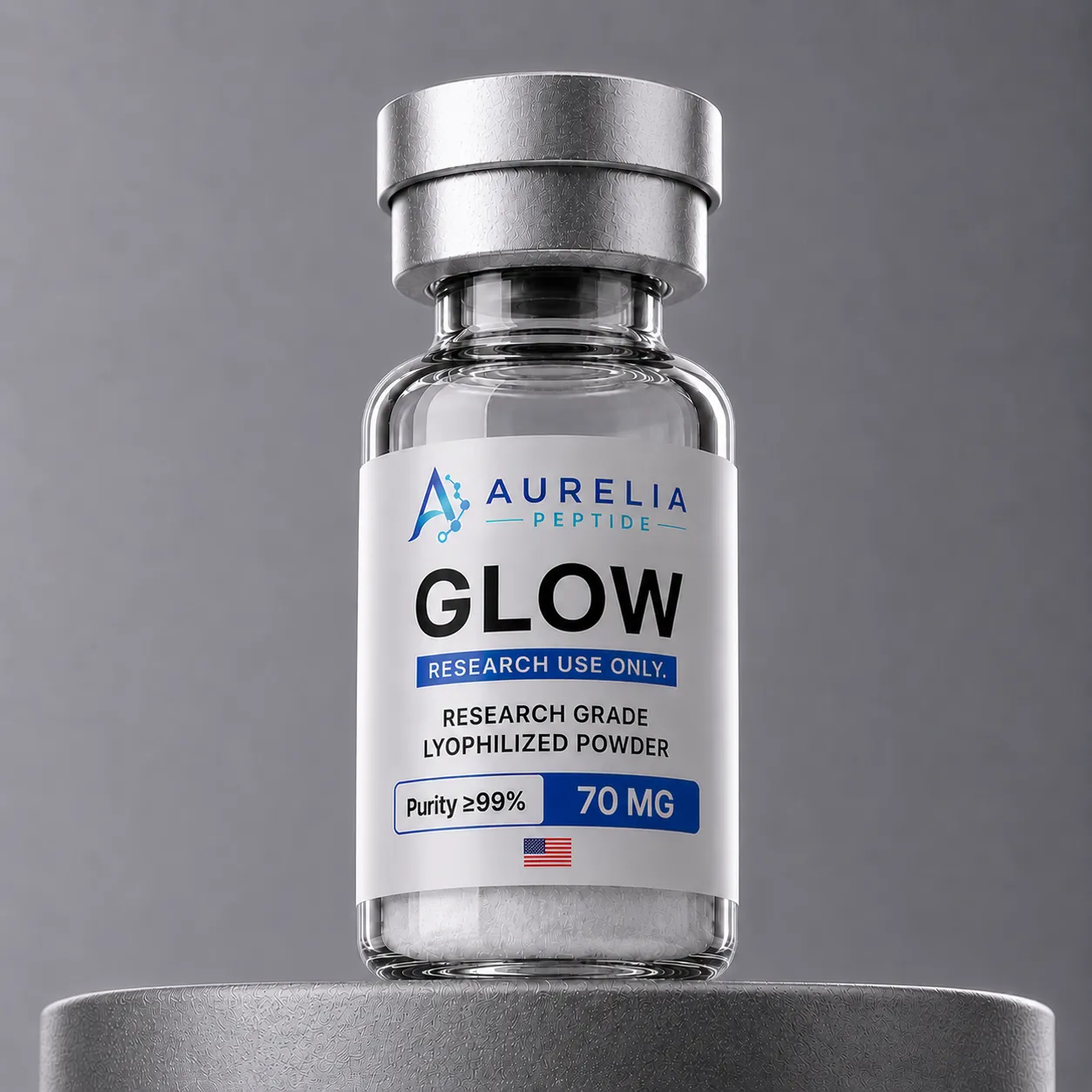
GLOW is a multi-component research blend configured as GHK-Cu, BPC-157 and thymosin-beta-4-related material. The three components are commonly investigated in separate extracellular-matrix, cell-migration, angiogenesis and tissue-remodeling research models. The combined formulation itself should not be presented as clinically validated, and findings from individual components do not establish the safety, efficacy or performance of the blend.
Three-peptide research blend · configured total 70 mg
- Formula
- Blend — no single molecular formula
- Molecular weight
- Blend — component-specific
- Form
- Lyophilized powder blend
- CAS / ID
- Blend — no single CAS identifier
Independently tested. Verifiably pure.
Every batch of Glow is reviewed against its independent laboratory documentation before fulfillment.
- HPLC Purity AnalysisReported purity: Component- and lot-specific purity — see COA
- Mass SpectrometryComponent identity by mass spectrometry — see lot COA
- Heavy Metals ScreeningLot-specific result — see COA
- Endotoxins (LPS)Lot-specific result — see COA
- Sterility TestingLot-specific result — see COA
- Net Peptide ContentTotal and component content — see COA
- HPLC Purity
- Component- and lot-specific purity — see COA
- Identity
- Component identity by mass spectrometry — see lot COA
- Endotoxin (LAL)
- Lot-specific result — see COA
- Lab
- Independent third-party laboratory
Not for human or veterinary use. For in-vitro laboratory research only. This product is not intended to diagnose, treat, cure, or prevent any disease.
Three molecular identities. One coordinated research format.
GLOW does not have one molecular formula or one molecular weight. It is a physical blend of three distinct research materials, each with its own analytical identity and literature context.
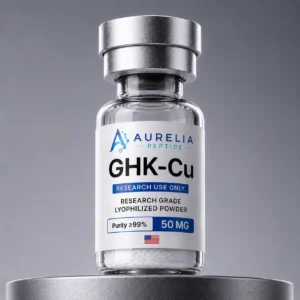
GHK-Cu · 50 mg
A copper-coordinating glycyl-L-histidyl-L-lysine complex studied in extracellular-matrix, fibroblast and skin-remodeling research.
BPC-157 · 10 mg
A synthetic 15-residue research peptide investigated primarily in preclinical angiogenesis, fibroblast and injury-model literature.
TB-500 / Tβ4 · 10 mg
Configured as thymosin-beta-4-related material studied in actin regulation, cell migration and tissue-remodeling models; exact supplied identity requires lot confirmation.
The GLOW tri-blend visualized.
The animated model displays three connected molecular nodes rather than a fictional single molecule. Each node represents a separate component and its principal research context.
Published component-level research observations.
These summaries refer to literature on the individual components. They are not evidence that the combined GLOW formulation has been clinically tested or that the components produce additive or synergistic effects in humans.
Matrix and skin-remodeling research
Published reviews discuss GHK-Cu in relation to collagen, glycosaminoglycans, fibroblast activity and tissue-remodeling pathways.
Fibroblast and angiogenesis models
Preclinical studies have examined tendon fibroblast migration, focal-adhesion signaling and vascular responses.
Cell migration and repair models
Thymosin beta-4 is a major G-actin-binding peptide investigated in epithelial migration, inflammation and wound-model research.
Visual percentages indicate relative prominence within this dossier, not efficacy, potency or clinical outcomes.
Three research pathways converge.
The animated signaling map separates the components and then brings their research contexts into a shared tissue-remodeling node. The map is illustrative and does not establish proven synergy.
Copper coordination and extracellular-matrix remodeling
GHK-Cu literature discusses collagen and glycosaminoglycan turnover, fibroblast signaling, antioxidant responses and matrix organization.
Fibroblast migration and angiogenesis-associated research
Preclinical work has examined FAK-paxillin signaling, tendon fibroblast behavior, nitric-oxide pathways and vascular responses.
G-actin regulation and epithelial cell migration
Thymosin beta-4 binds monomeric actin and is studied in cell motility, re-epithelialization and inflammatory-response models.
What each component contributes to the research design.
This table distinguishes molecular identity and literature focus. It does not compare therapeutic effectiveness.
GHK-Cu
A copper peptide complex with a strong skin, fibroblast and extracellular-matrix research profile.
BPC-157
A 15-residue synthetic peptide with predominantly preclinical tendon, gastrointestinal and vascular literature.
TB-500 / thymosin beta-4
An actin-associated peptide researched in migration, epithelial, corneal, dermal and cardiac models.
| Component | Molecular class | Defining feature | Primary research context |
|---|---|---|---|
| GHK-Cu | Copper tripeptide complex | Copper coordination | Matrix, fibroblast and skin-remodeling models |
| BPC-157 | 15-residue synthetic peptide | Preclinical fibroblast and vascular signaling | Tendon, GI and injury models |
| TB-500 / Tβ4 | Thymosin-beta-4-related peptide | G-actin binding | Migration, epithelial and repair models |
Tri-pathway profile visualized.
The bars show how the dossier distributes attention across the three component research themes. They are not concentration-response or clinical-performance values.
A blend has no single half-life.
Each component has distinct degradation, binding and exposure behavior. A universal half-life or dosing interval for the combined blend should not be claimed without formulation-, route- and model-specific data.
Component-specific behavior
GHK-Cu, BPC-157 and thymosin-beta-4-related material must be treated as separate analytical entities.
No blend molecular weight
The vial has a total peptide mass, but the blend does not become one covalently linked molecule.
No universal pharmacokinetic profile
Published component data cannot be combined into one validated blend pharmacokinetic claim.
Percentages reflect nominal mass composition only.
Full specification.
Nominal composition is separated from lot-specific analytical measurements. Final published values must match the actual supplier specification and Certificate of Analysis.
GLOW
Three-component lyophilized research blend.
50 mg + 10 mg + 10 mg
GHK-Cu + BPC-157 + TB-500/Tβ4; total 70 mg.
Not applicable to the blend
Each component retains a separate molecular identity.
Component-specific
Do not publish a single blend molecular weight.
Lyophilized powder
Appearance and fill characteristics must be confirmed per lot.
See lot COA
Confirm component identity, purity, content and applicable contaminant testing.
From molecular identity to coordinated research design.
The timeline illustrates a logical experimental sequence rather than a biological treatment timeline.
Verify all three identities
Confirm sequence, molecular form, copper complex, counterion and per-component content using supplier documentation and lot analytics.
Define the experimental model
Select matrix, fibroblast, epithelial, vascular or migration endpoints appropriate to the research question.
Separate component controls
Include individual-component and vehicle controls so blend effects are not incorrectly attributed.
Evaluate interaction
Only describe additivity or synergy after the study design directly demonstrates it.
Handle the blend as three sensitive research materials.
Storage, preparation and working stability must follow supplier-validated documentation. A generic website statement should not override the actual lot specification.
Cold, dry and protected
Minimize moisture, repeated temperature cycling and direct light. Use the validated storage condition stated for the supplied lot.
Time and matrix matter
Stability depends on solvent, concentration, container, pH, temperature and handling conditions.
Avoid incompatible conditions
GHK-Cu behavior may be affected by chelators, competing ligands, pH and redox-active components in the experimental matrix.
- Record the lotLink each experiment to the vial batch and corresponding COA.
- Use validated preparation instructionsDo not infer solvent or stability solely from another product page.
- Limit freeze-thaw cyclesPrepare appropriate aliquots when supported by the experimental protocol.
- Document hold timeRecord preparation time, temperature and elapsed time before analysis.
For in-vitro laboratory research only. Not for human or veterinary use.
Component literature library.
The literature below supports the scientific context of the individual components. It does not validate the combined GLOW formulation as a clinical product.
Review of GHK/GHK-Cu in skin regeneration, extracellular-matrix turnover, fibroblast biology and gene-expression research.
View primary source →Review discussing connective-tissue remodeling, collagen, elastin and glycosaminoglycan research associated with GHK-Cu.
View primary source →Preclinical tendon-fibroblast study examining growth-hormone-receptor expression and cell behavior.
View primary source →In-vitro and animal research examining tendon fibroblast outgrowth, survival, migration and focal-adhesion signaling.
View primary source →Review of actin binding, cell migration and regenerative research involving thymosin beta-4.
View primary source →Animal-model research examining keratinocyte migration, wound contraction and collagen deposition.
View primary source →References.
Independent literature supporting the component-level scientific context used in this dossier.
- Pickart L, Vasquez-Soltero JM, Margolina A. GHK peptide as a natural modulator of multiple cellular pathways in skin regeneration. BioMed Res Int. 2015;2015:648108.Open source ↗
- Pickart L, Margolina A. Regenerative and protective actions of the GHK-Cu peptide in the light of the new gene data. Int J Mol Sci. 2018;19(7):1987.Open source ↗
- Chang CH et al. Pentadecapeptide BPC 157 enhances the growth hormone receptor expression in tendon fibroblasts. Molecules. 2014;19(11):19066-19077.Open source ↗
- Chang CH et al. The promoting effect of pentadecapeptide BPC 157 on tendon healing involves tendon outgrowth, cell survival, and cell migration. J Appl Physiol. 2011;110(3):774-780.Open source ↗
- Goldstein AL, Kleinman HK. Thymosin beta-4: a multi-functional regenerative peptide. Basic properties and clinical applications. Expert Opin Biol Ther. 2012;12(1):37-51.Open source ↗
- Philp D et al. Thymosin beta 4 and a synthetic peptide containing its actin-binding domain promote dermal wound repair in aged mice. Wound Repair Regen. 2003;11(1):19-24.Open source ↗
Related products
ARA-290
BPC-157
GHK-Cu
KLOW Blend
KPV