
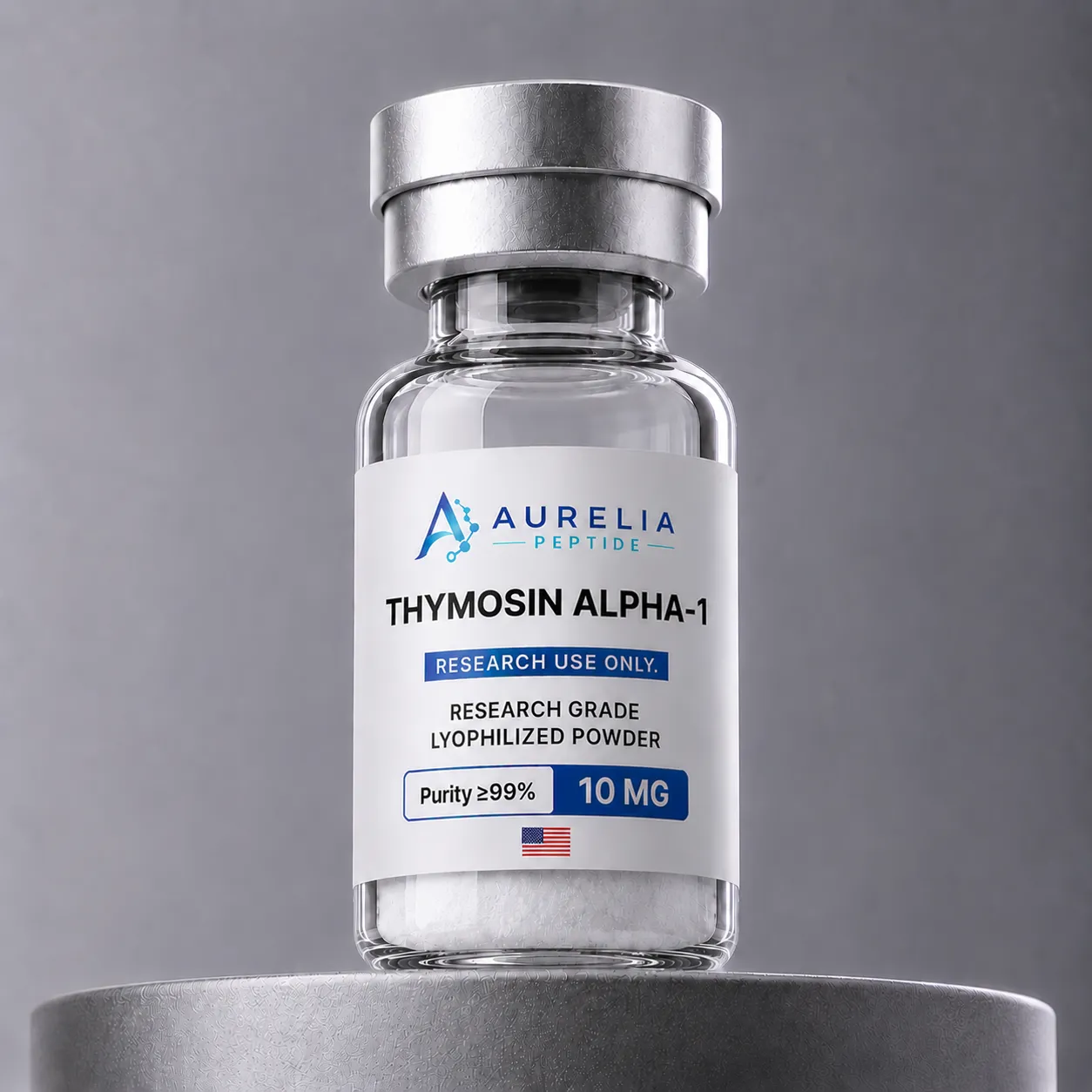
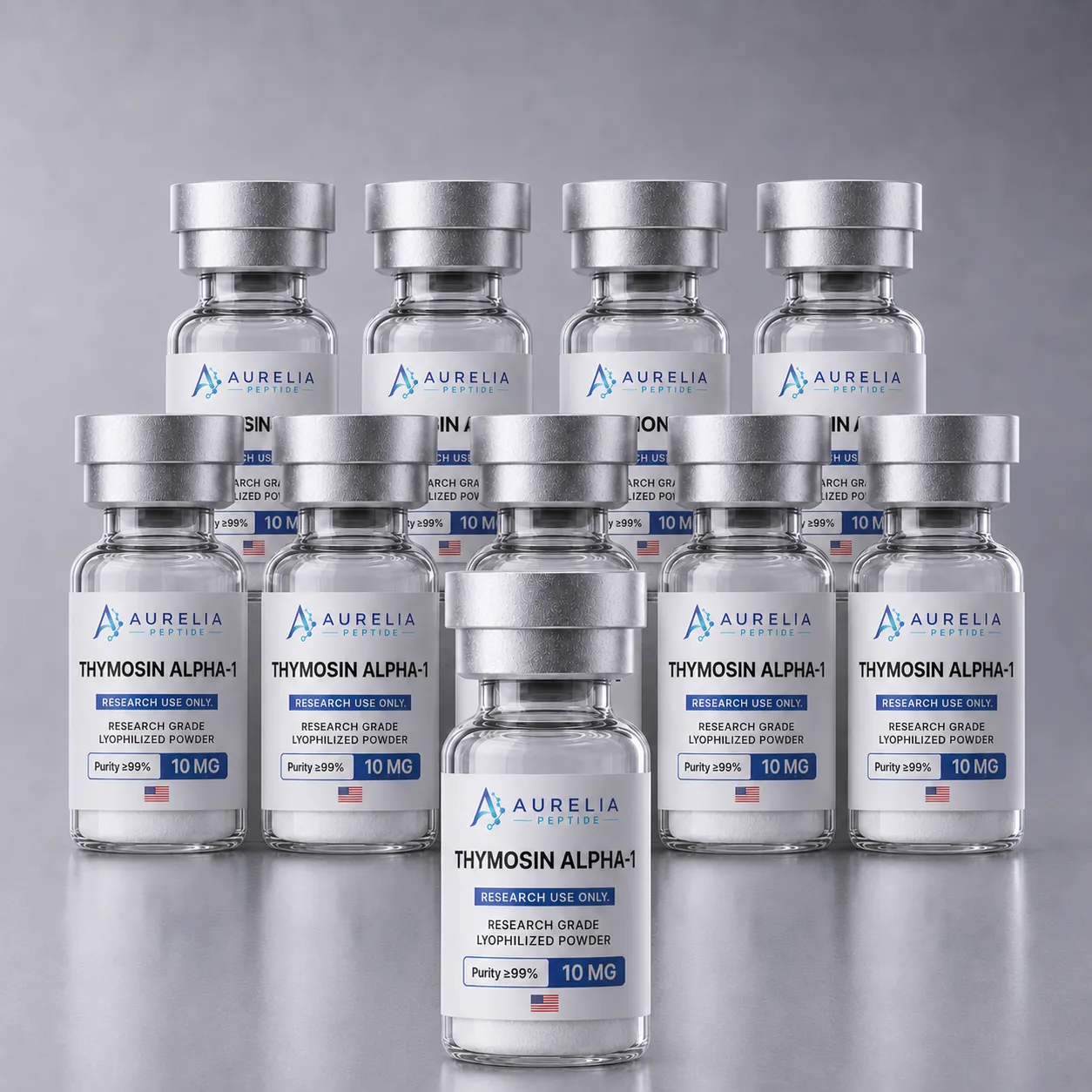
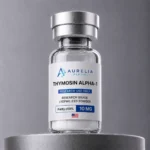
Thymosin Alpha-1
A naturally occurring 28-residue thymic peptide studied for innate and adaptive immune regulation
- Fulfillment Origin
- us
Thymosin Alpha-1 is an N-terminally acetylated 28-amino-acid peptide derived from prothymosin alpha. Research examines its effects on dendritic-cell maturation, Toll-like-receptor signaling, T-lymphocyte differentiation, natural-killer-cell activity and coordination of innate and adaptive immune responses.
Acetylated thymic peptide · Immunoregulatory research peptide
- Formula
- C129H215N33O55
- Molecular weight
- 3108.3 g/mol
- Form
- Lyophilized powder
- CAS / ID
- 62304-98-7
Independently tested. Verifiably pure.
Every batch of Thymosin Alpha-1 is reviewed against its independent laboratory documentation before fulfillment.
- HPLC Purity AnalysisReported purity: Lot-specific purity — see COA
- Mass SpectrometryMass-spectrometric identity — see lot COA
- Heavy Metals ScreeningLot-specific result — see COA
- Endotoxins (LPS)Lot-specific result — see COA
- Sterility TestingLot-specific result — see COA
- Net Peptide ContentLot-specific result — see COA
- HPLC Purity
- Lot-specific purity — see COA
- Identity
- Mass-spectrometric identity — see lot COA
- Endotoxin (LAL)
- Lot-specific result — see COA
- Lab
- Independent third-party laboratory
Not for human or veterinary use. For in-vitro laboratory research only. This product is not intended to diagnose, treat, cure, or prevent any disease.
A 28-residue thymic peptide at the intersection of innate and adaptive immunity.
Thymosin Alpha-1 is the acetylated N-terminal 28-residue fragment of prothymosin alpha. Its acidic sequence and compact peptide architecture have been studied across dendritic-cell, T-cell, natural-killer-cell and cytokine models.
Acetylated 28-residue peptide
A defined thymic peptide also known by the generic name thymalfasin.
TLR and immune-cell signaling
Investigated in TLR2, TLR9, dendritic-cell, monocyte and lymphocyte models.
Immune coordination
Used to study maturation, activation, cytokine balance and restoration of immune-cell function.
The Thymosin Alpha-1 molecule visualized.
The animated model represents its N-terminal acetyl group, 28-residue peptide backbone and acidic amino-acid distribution.
Published research areas associated with Thymosin Alpha-1.
The summaries below describe immunology research themes and are not directions for administration or clinical use.
T-lymphocyte maturation
Research examines T-cell differentiation, CD4/CD8 balance and recovery of lymphocyte function.
Dendritic and natural-killer cells
Studies report dendritic-cell maturation and modulation of natural-killer-cell activity.
Toll-like-receptor signaling
Experimental work links the peptide to TLR-dependent innate immune activation and cytokine regulation.
Thymosin Alpha-1 signaling pathways visualized.
The animated pathway map connects Toll-like-receptor engagement with dendritic-cell maturation, cytokine signaling and adaptive immune-cell responses.
Toll-like-receptor signaling
Thymosin Alpha-1 is studied in TLR-dependent activation of dendritic cells and monocytes.
Innate transcriptional response
Downstream signaling can influence inflammatory mediators, antigen presentation and immune-cell activation.
T-cell differentiation and balance
Research examines maturation, proliferation and functional balance among T-cell populations.
Natural-killer and Th1 signaling
Studies investigate NK-cell activity and Th1-associated cytokines including interferon-gamma and interleukin-2.
How Thymosin Alpha-1 differs from Thymosin Beta-4.
Both are thymosin-family peptides, but their sequences, biological targets and principal research applications are distinct.
Immune-regulatory peptide
A 28-residue acetylated peptide studied primarily in innate and adaptive immune signaling.
Actin-binding peptide
A 43-residue peptide studied in actin sequestration, cell migration and tissue-repair models.
Immune signaling versus cytoskeletal biology
The two compounds should not be treated as interchangeable thymic peptides.
| Compound | Length | Primary research area | Representative mechanism |
|---|---|---|---|
| Thymosin Alpha-1 | 28 residues | Immune modulation | TLR, dendritic-cell and T-cell signaling |
| Thymosin Beta-4 | 43 residues | Repair and migration | G-actin binding and cytoskeletal regulation |
Immune-system research emphasis visualized.
These bars summarize the major research domains and are not quantitative receptor-binding measurements.
A short peptide with rapid direct exposure and broader immune-network effects.
Published pharmacokinetic values vary with formulation, route, assay and study population. Direct peptide exposure should be distinguished from later cellular and cytokine responses.
Compact immune peptide
The 28-residue structure is much smaller than full-length cytokines and immune glycoproteins.
Effects can outlast peptide exposure
Dendritic-cell maturation, transcriptional changes and lymphocyte activation may continue after direct exposure declines.
Use analytical documentation
Identity, purity and net peptide content should be verified using the actual Aurelia lot COA.
Full specification.
The fields below describe compound identity. Final analytical values must match the actual Aurelia lot documentation.
Thymosin Alpha-1
Synthetic form commonly known as thymalfasin.
Acetylated thymic peptide
N-terminally acetylated 28-residue peptide.
Ac-SDAAVDTSSEITTKDLKEKKEVVEEAEN-OH
Human Thymosin Alpha-1 sequence.
28 residues
Derived from the N-terminal region of prothymosin alpha.
C129H215N33O55
Elemental composition of Thymosin Alpha-1.
3108.3 g/mol
Calculated molecular mass.
62304-98-7
Common Thymosin Alpha-1 identifier.
See lot COA
Confirm identity, purity, net content, sterility and endotoxin results.
From innate sensing to adaptive immune coordination.
This is an illustrative mechanistic sequence, not a dosing or treatment timeline.
TLR-associated immune sensing
The peptide interacts with innate immune signaling in dendritic cells and monocytes.
Dendritic-cell maturation
Antigen-presentation capacity and immune-cell communication are modulated.
T-cell and NK-cell activation
Adaptive and cytotoxic immune-cell functions are recruited.
Cytokine balancing
Th1-associated and regulatory cytokine networks shape the overall immune response.
Handle as a sensitive acetylated peptide.
Use storage conditions validated for the actual Aurelia lot and document all preparation and hold-time variables.
Cold, dry and protected
Protect from moisture, direct light, excessive heat and repeated temperature cycling.
Solution stability is conditional
Stability depends on solvent, pH, concentration, container, temperature and contamination control.
Minimize adsorption and degradation
Use validated low-binding containers and avoid unnecessary agitation.
- Record the lotLink every experiment to the vial identifier and corresponding COA.
- Follow validated storageUse the temperature range stated on the Aurelia label and lot documentation.
- Minimize cyclingAvoid repeated warming, cooling or freeze-thaw events.
- Document preparationRecord solvent, concentration, pH, container, temperature and elapsed hold time.
For in-vitro laboratory research only. Not for human or veterinary use.
Thymosin Alpha-1 literature library.
The publications below provide context for immune modulation, Toll-like-receptor signaling and infectious-disease research.
A review of the peptide's effects on innate and adaptive immune responses.
View primary source →A broad review covering immunologic mechanisms and published clinical research.
View primary source →A review describing T-cell, dendritic-cell, antibody and cytokine effects.
View primary source →A recent review of immune-cell and Toll-like-receptor pathways in viral research.
View primary source →References.
Independent literature supporting the molecular and mechanistic context used in this dossier.
- King R, Tuthill C. Immune Modulation with Thymosin Alpha-1 Treatment. Vitamins and Hormones. 2016.Open source ↗
- Dominari A et al. Thymosin Alpha-1: A Comprehensive Review of the Literature. 2020.Open source ↗
- Li J et al. Thymosin Alpha-1: Biological Activities, Applications and Mechanisms. 2010.Open source ↗
- Thymosin Alpha-1 and Its Role in Viral Infectious Diseases. 2023.Open source ↗
Related products
L-Glutathione
MOTS-c
NAD+
Pinealon
Selank