
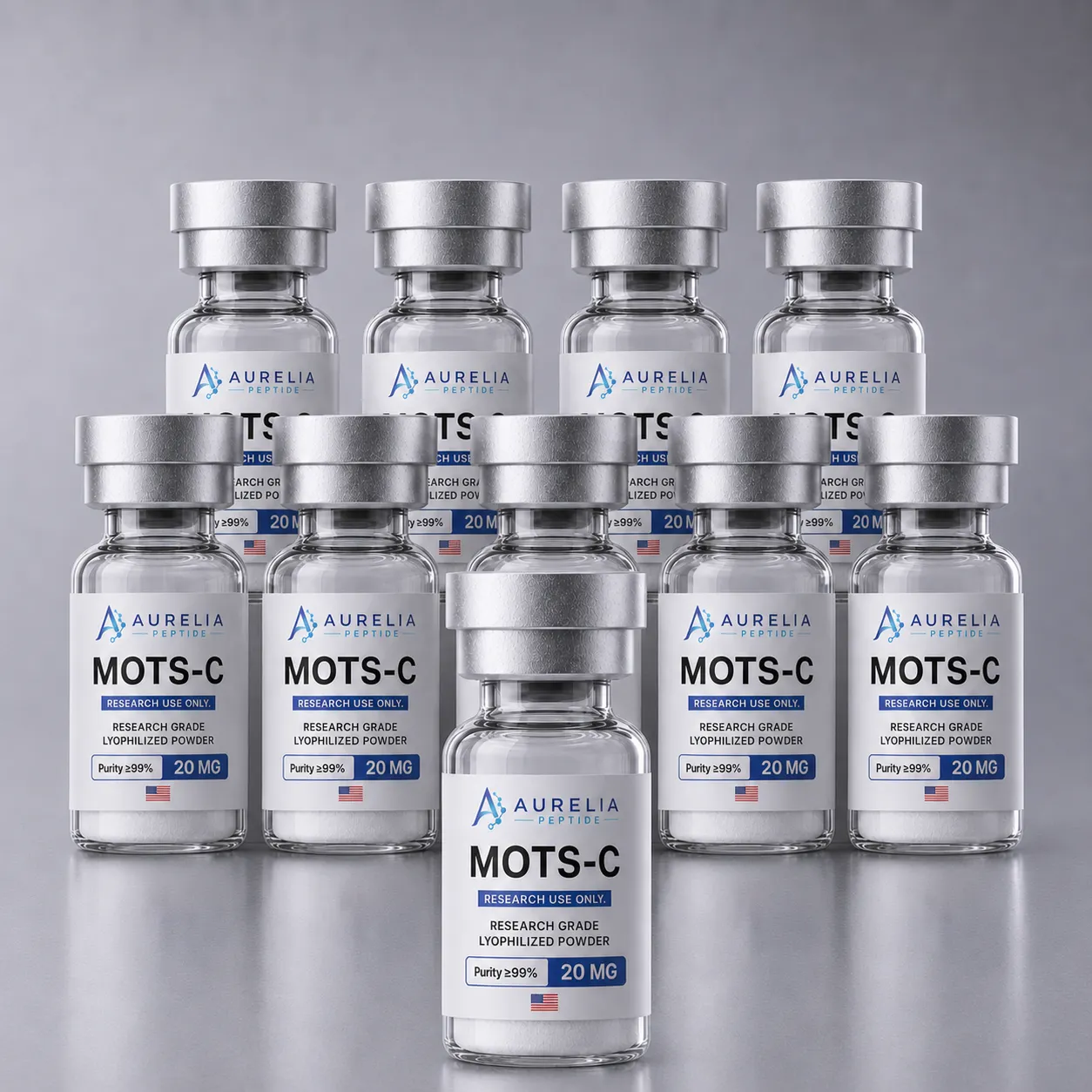
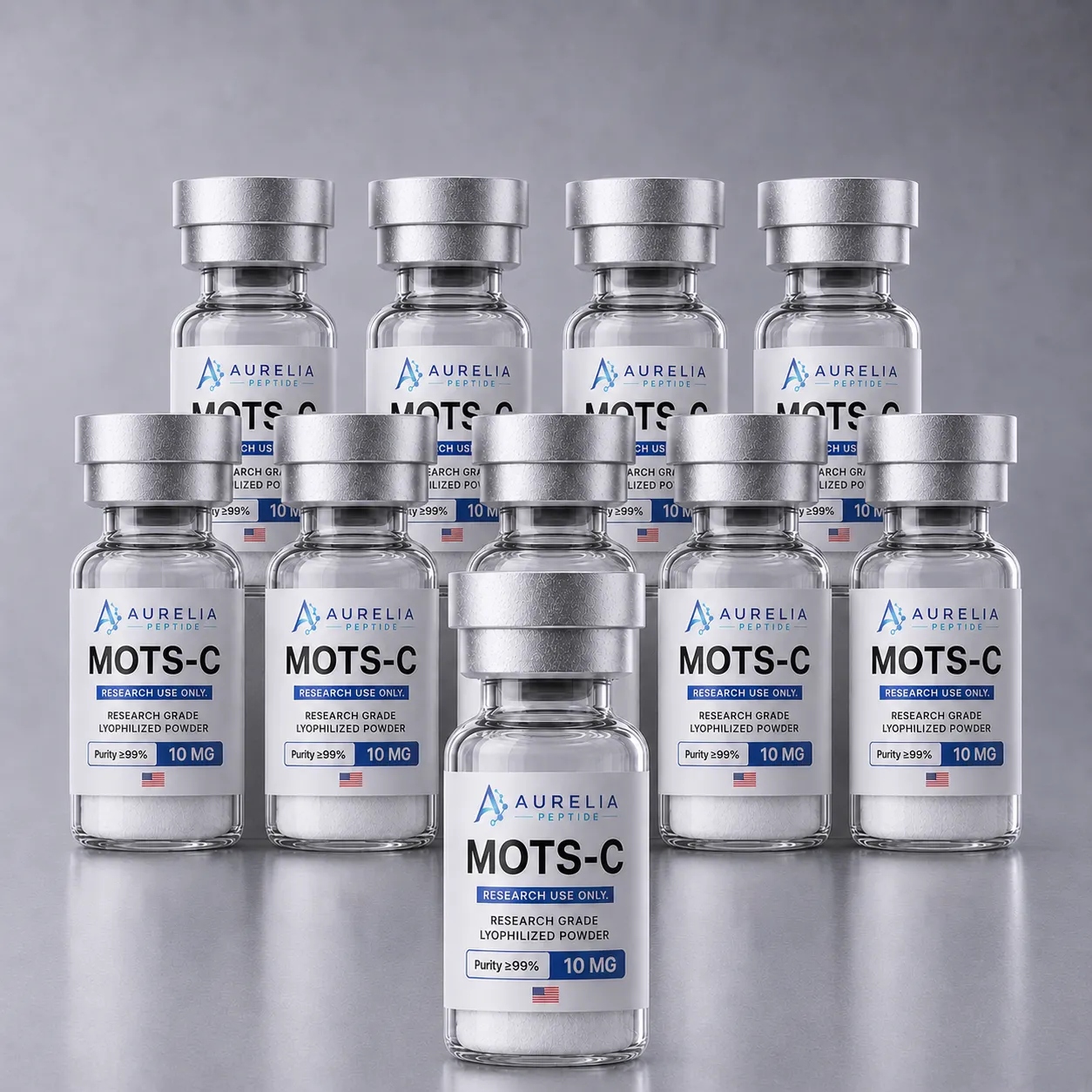
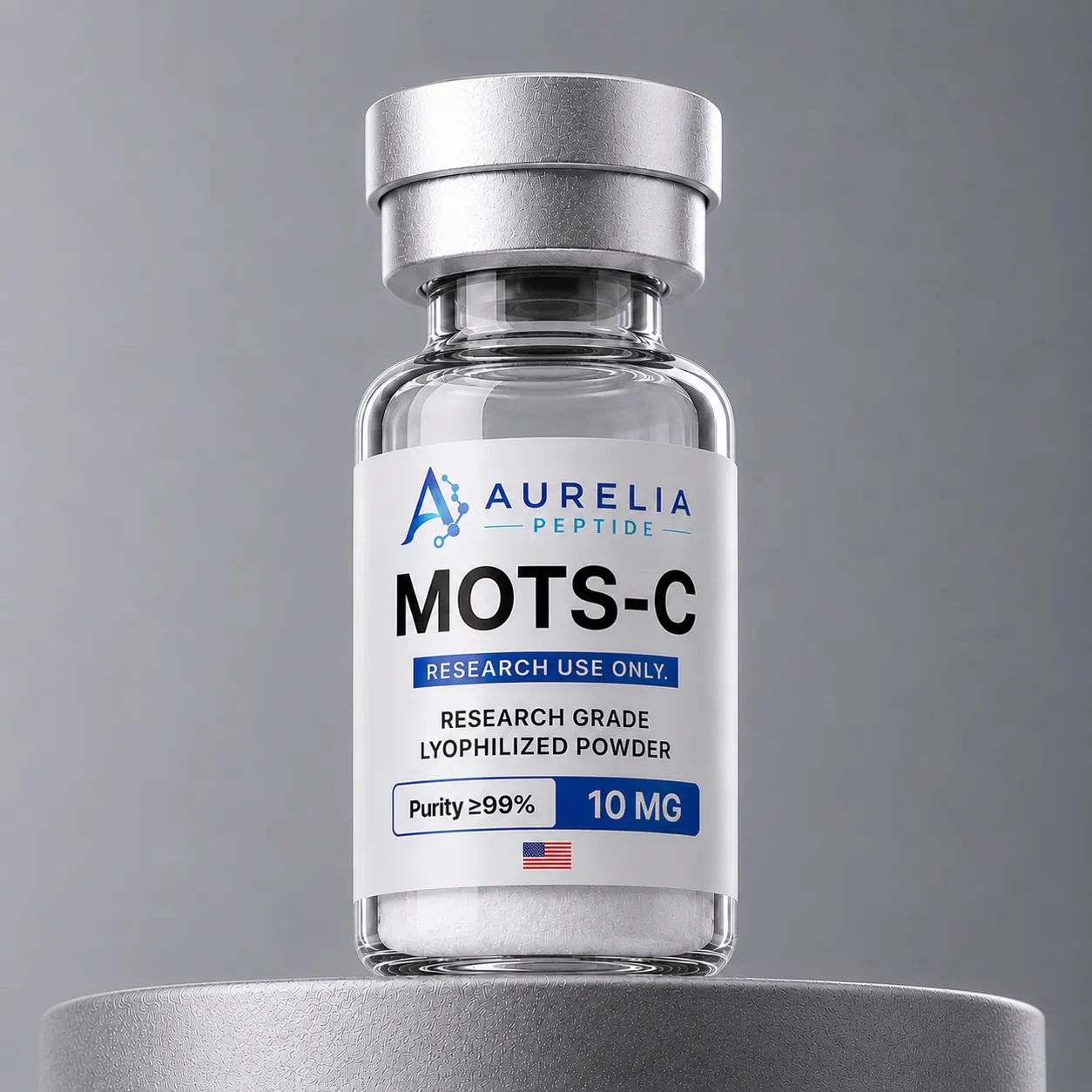
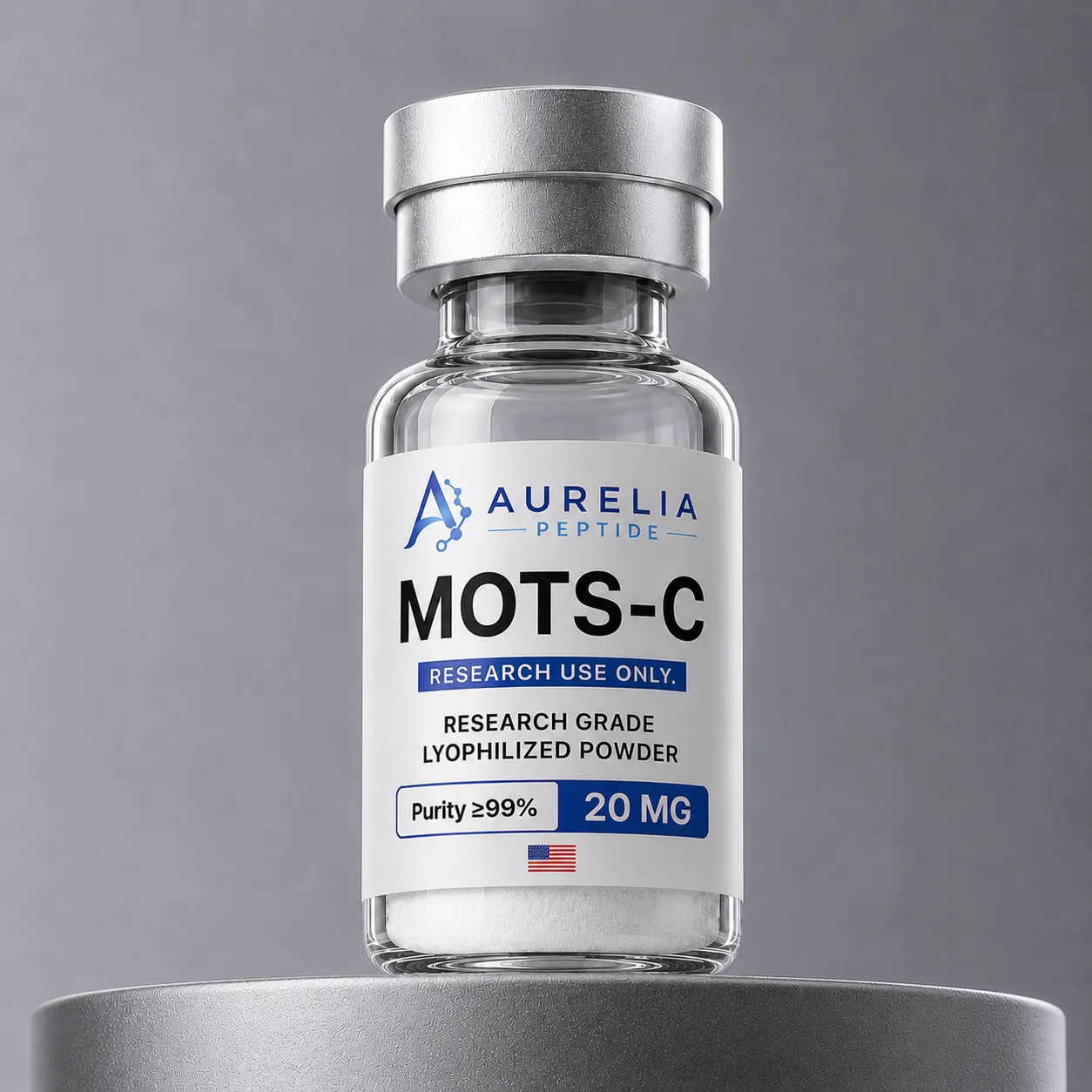
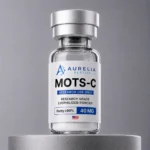





MOTS-c
A mitochondrial-derived 16-amino-acid peptide studied in metabolic-stress and exercise biology
- Fulfillment Origin
- us
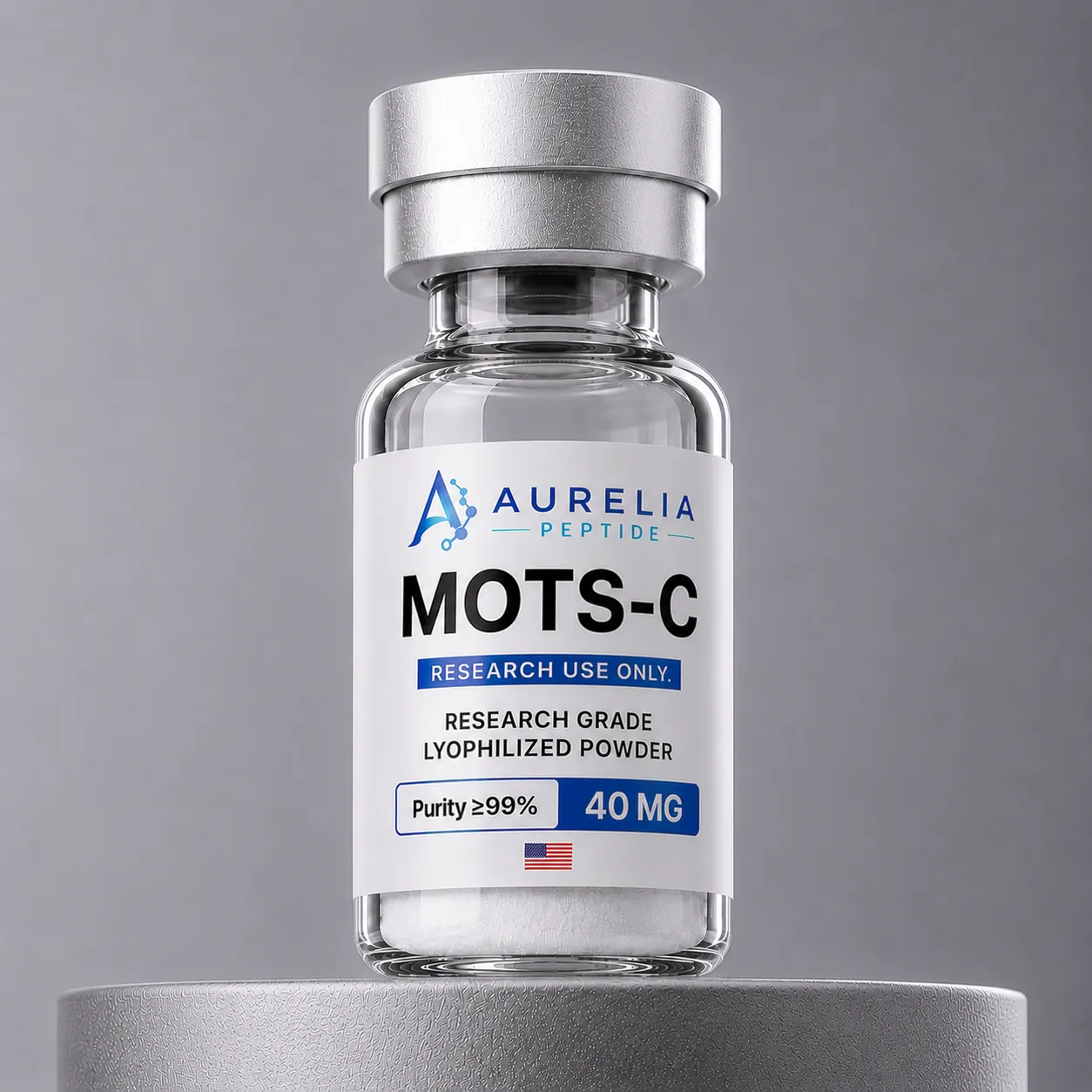
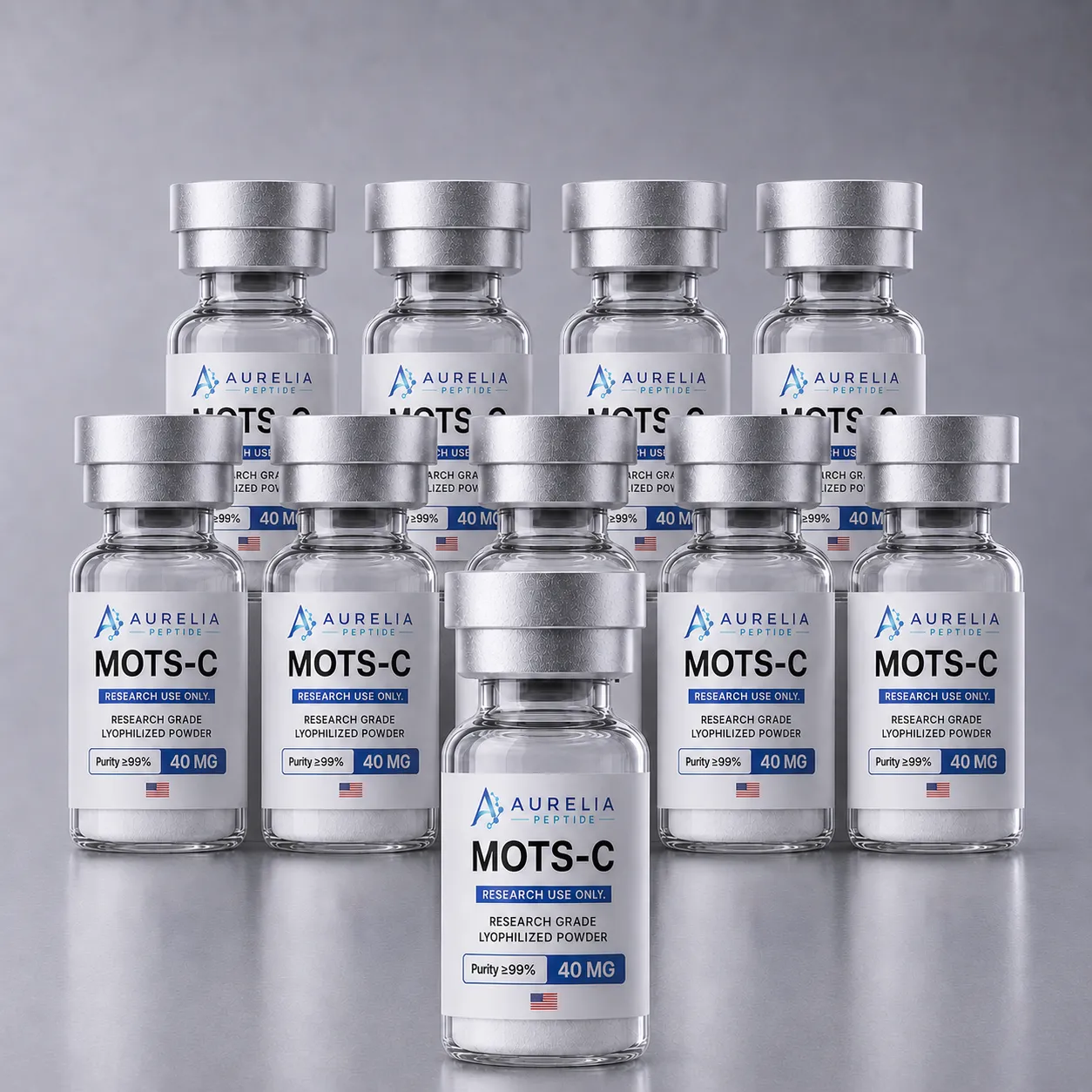
MOTS-C is a 16-amino-acid mitochondrial-derived peptide encoded within the mitochondrial 12S rRNA region. Published research examines metabolic homeostasis, AMPK-associated signaling, mitonuclear communication, exercise responses and age-related physiology. Evidence concerning externally supplied MOTS-C remains predominantly preclinical.
Mitochondrial-derived 16-amino-acid peptide (MRWQEMGYIFYPRKLR)
- Formula
- C101H152N28O22S2
- Molecular weight
- 2174.6 g/mol
- Form
- Lyophilized powder
- CAS / ID
- 1627580-64-6 / PubChem CID 155885767
Independently tested. Verifiably pure.
Every batch of MOTS-c is reviewed against its independent laboratory documentation before fulfillment.
- HPLC Purity AnalysisReported purity: Lot-specific purity — see COA
- Mass SpectrometryMass spectrometry — see lot COA
- Heavy Metals ScreeningLot-specific result — see COA
- Endotoxins (LPS)Lot-specific result — see COA
- Sterility TestingLot-specific result — see COA
- Net Peptide ContentLot-specific result — see COA
- HPLC Purity
- Lot-specific purity — see COA
- Identity
- Mass spectrometry — see lot COA
- Endotoxin (LAL)
- Lot-specific result — see COA
- Lab
- Independent third-party laboratory
Not for human or veterinary use. For in-vitro laboratory research only. This product is not intended to diagnose, treat, cure, or prevent any disease.
Mitochondrial origin. Sixteen amino acids.
MOTS-C is encoded by a short open reading frame within the mitochondrial 12S rRNA region. The human sequence MRWQEMGYIFYPRKLR has been studied as a signal connecting mitochondrial metabolic state with cellular and nuclear responses.
MRWQEMGYIFYPRKLR
A linear peptide containing 16 amino-acid residues.
Mitochondrial 12S rRNA region
MOTS-C belongs to the mitochondrial-derived peptide family.
Metabolic-stress signaling
Published studies examine AMPK, folate and purine metabolism, nuclear stress responses and exercise biology.
The MOTS-C molecule
An interactive illustrative atomic representation generated from the public compound record, alongside verified molecular data. The figure is schematic and is not a measured solution conformation.
Published research observations.
Selected cell, animal and observational human findings are shown for research context. They do not establish the efficacy, safety or suitability of externally supplied MOTS-C in humans.
Mitochondrial-derived peptide
The human reference sequence is MRWQEMGYIFYPRKLR.
Metabolic homeostasis studied
The original Cell Metabolism report examined glucose regulation and insulin sensitivity in cellular and mouse models.
Exercise response examined
Endogenous MOTS-C was measured in human exercise samples, while intervention experiments were performed in mice and cells.
Mitochondrial signal. Multiple adaptive pathways.
MOTS-C research links mitochondrial metabolism with cytosolic energy sensing and stress-dependent nuclear gene regulation. The described mechanisms depend on model and experimental conditions.
Energy-sensing pathways
Cell and animal studies connect MOTS-C with folate and purine metabolism, AICAR-related signaling and AMPK activation.
Mitonuclear communication
Under metabolic stress, MOTS-C has been reported to translocate to the nucleus and influence stress-responsive gene expression.
Exercise and metabolic adaptation
Published work examines endogenous exercise responses, skeletal-muscle metabolism and physical-capacity outcomes in experimental models.
Where MOTS-C fits.
This table organizes selected research peptides by biological origin and principal research context. It is not a comparison of clinical efficacy or approved use.
MOTS-C
A 16-residue mtDNA-encoded peptide associated with metabolic-stress signaling.
GLP-1 analogs
Receptor agonist peptides with a different origin and signaling mechanism.
5-Amino-1MQ
A small-molecule NNMT inhibitor rather than a peptide.
| Research molecule | Class | Primary feature | Research context |
|---|---|---|---|
| MOTS-C | Mitochondrial-derived peptide | 16-residue mtDNA product | Metabolic stress and exercise |
| GLP-1 analog | Receptor agonist peptide | GLP-1R signaling | Incretin biology |
| 5-Amino-1MQ | Small molecule | NNMT inhibition | Cellular metabolism |
Research profile visualized.
Qualitative bars summarize major published research themes. They are not receptor-potency, treatment-effect or clinical-performance measurements.
A compact mitochondrial signaling peptide.
MOTS-C is structurally smaller than many receptor-agonist peptides. Exposure and stability of supplied peptide depend on formulation, route and experimental conditions; no dosing guidance is provided here.
Linear peptide
The reference sequence contains 16 amino-acid residues.
Public compound value
Molecular weight in grams per mole for the public parent-peptide record.
Two methionine residues
The sequence contains methionine at positions 1 and 6.
Full specification.
Public compound identity is shown separately from lot-specific counterion, purity, identity and net-peptide measurements.
Mitochondrial ORF of 12S rRNA type-c
Commonly abbreviated MOTS-C.
C101H152N28O22S2
Public parent-peptide formula; this corrects the O25 formula displayed on the reference seller page.
2174.6 g/mol
Public parent-peptide molecular weight.
MRWQEMGYIFYPRKLR
Sixteen-residue human MOTS-C reference sequence.
Mitochondrial 12S rRNA
Encoded within the mitochondrial MT-RNR1 region.
See selected COA
Purity, identity, counterion, water, endotoxin and net content are lot-specific.
MOTS-C research development.
Selected milestones show the progression from discovery to studies of nuclear signaling, exercise responses and genetic variation.
Stress, metabolism and aging review
A review consolidated research on AMPK, nuclear translocation, metabolic homeostasis and aging-related models.
Exercise and physical-decline study
A Nature Communications study measured endogenous exercise responses in humans and tested intervention outcomes in mice and cells.
Nuclear translocation reported
Cell Metabolism research described stress-dependent nuclear localization and regulation of stress-responsive genes.
MOTS-C metabolic research introduced
The original Cell Metabolism paper characterized MOTS-C and studied metabolic homeostasis in cells and mice.
Handling and documentation.
Storage and prepared-material stability depend on the supplied form, formulation, container, concentration and lot. Follow the product label and available supplier-validated documentation.
Follow documented storage
Keep lyophilized material within the conditions documented by the supplier.
Minimize exposure
Keep the container closed and use appropriate laboratory monitoring and handling.
Use validated stability data
Stability depends on solvent, pH, concentration, container, temperature and handling.
- Check the lot recordMatch the vial identifier with its available Certificate of Analysis.
- Confirm material formIdentify the documented peptide, counterion and net-peptide basis.
- Use a validated methodHandle laboratory material using qualified equipment and an approved protocol.
- Record handlingDocument lot, solvent, concentration, container, conditions and disposition.
Featured MOTS-C research.
Explore selected public compound data and peer-reviewed studies. Human findings mainly concern endogenous MOTS-C measurements; intervention evidence is predominantly cellular or animal.
Public molecular formula, molecular weight, sequence and structure record.
View primary source →The discovery study examined folate metabolism, AMPK-associated signaling, obesity and insulin resistance in cells and mice.
View primary source →Cell research examined AMPK-dependent nuclear translocation and stress-responsive gene expression.
View primary source →The study measured endogenous responses in human exercise samples and evaluated physical and metabolic outcomes in mice and cells.
View primary source →A review of mitochondrial origin, AMPK signaling, nuclear responses, exercise and aging-related research.
View primary source →Human cohort and experimental research examined the East Asian-specific K14Q variant and metabolic associations.
View primary source →References.
Government compound data and peer-reviewed publications used for this dossier.
- PubChem. MOTS-C (human), CID 155885767.Open source ↗
- Lee C, et al. The mitochondrial-derived peptide MOTS-c promotes metabolic homeostasis and reduces obesity and insulin resistance. Cell Metabolism. 2015.Open source ↗
- Kim KH, et al. MOTS-c translocates to the nucleus to regulate nuclear gene expression in response to metabolic stress. Cell Metabolism. 2018.Open source ↗
- Reynolds JC, et al. MOTS-c is an exercise-induced mitochondrial-encoded regulator of age-dependent physical decline and muscle homeostasis. Nature Communications. 2021.Open source ↗
- Wan W, et al. Mitochondria-derived peptide MOTS-c: effects and mechanisms related to stress, metabolism and aging. Journal of Translational Medicine. 2023.Open source ↗
- Fuku N, et al. A pro-diabetogenic mtDNA polymorphism in the mitochondrial-derived peptide MOTS-c. Aging Cell. 2021.Open source ↗
Related products
L-Glutathione

NAD+


Pinealon


Selank

Semax