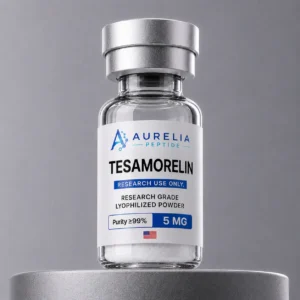

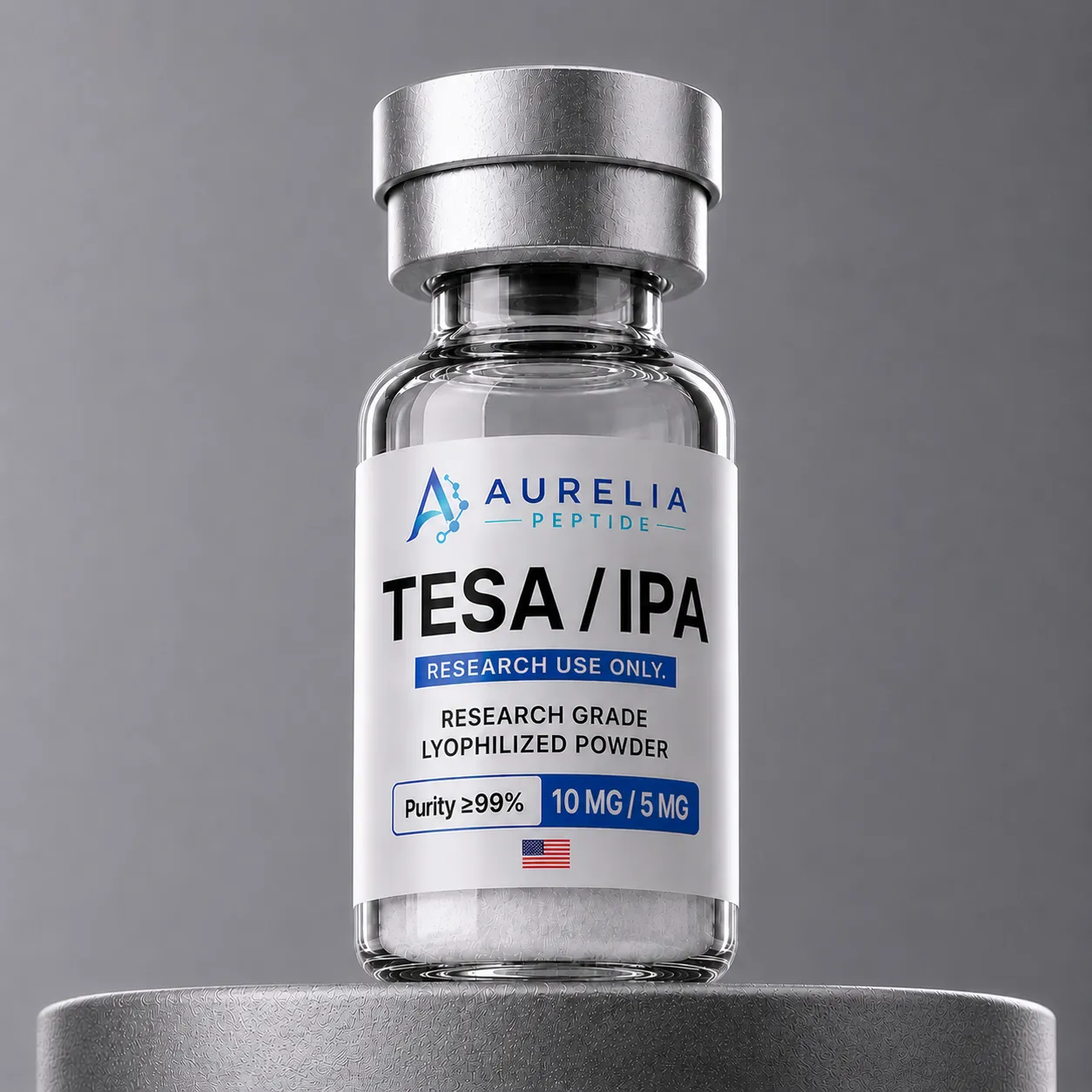
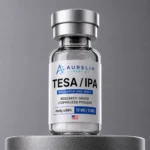
TESA / IPA Blend
A dual-pathway GH-axis research blend combining GHRH-R and GHS-R1a signaling
- Fulfillment Origin
- us
TESA / IPA Blend combines Tesamorelin, a stabilized growth-hormone-releasing-hormone analog, with Ipamorelin, a selective growth-hormone secretagogue. The two components are investigated through distinct pituitary receptor systems that converge on endogenous growth-hormone release and downstream IGF-1 signaling. Findings from either component do not establish the safety, efficacy or clinical performance of the blend.
Two-peptide research blend · configured total 14 mg
- Formula
- Tesamorelin: C221H366N72O67S; Ipamorelin: C38H49N9O5
- Molecular weight
- Tesamorelin: 5135.8 Da; Ipamorelin: 711.86 Da
- Form
- Lyophilized powder blend
- CAS / ID
- Tesamorelin: 218949-48-5; Ipamorelin: 170851-70-4
Independently tested. Verifiably pure.
Every batch of TESA / IPA Blend is reviewed against its independent laboratory documentation before fulfillment.
- HPLC Purity AnalysisReported purity: Component- and lot-specific purity — see COA
- Mass SpectrometryComponent identity by mass spectrometry — see lot COA
- Heavy Metals ScreeningLot-specific result — see COA
- Endotoxins (LPS)Lot-specific result — see COA
- Sterility TestingLot-specific result — see COA
- Net Peptide ContentTotal and component content — see COA
- HPLC Purity
- Component- and lot-specific purity — see COA
- Identity
- Component identity by mass spectrometry — see lot COA
- Endotoxin (LAL)
- Lot-specific result — see COA
- Lab
- Independent third-party laboratory
Not for human or veterinary use. For in-vitro laboratory research only. This product is not intended to diagnose, treat, cure, or prevent any disease.
Two molecular signals. One convergent endocrine research model.
TESA / IPA Blend contains two independent peptide identities. Tesamorelin engages the GHRH receptor, while Ipamorelin engages the ghrelin receptor GHS-R1a. Both pathways converge on endogenous pituitary growth-hormone secretion.
Tesamorelin · 12 mg
A stabilized 44-residue analog of human GHRH studied for pituitary GHRH-receptor activation, pulsatile GH release and downstream IGF-1 signaling.
Ipamorelin · 2 mg
A synthetic pentapeptide growth-hormone secretagogue investigated for selective GHS-R1a activation and GH release.
Dual-axis signaling
The blend provides a research format for studying simultaneous GHRH-R and GHS-R1a stimulation without representing exogenous growth hormone.
The TESA / IPA dual-peptide model.
The animated diagram presents two distinct peptide structures and two receptor pathways converging at the pituitary GH node. It does not depict the blend as a single covalently linked molecule.
Published component-level research observations.
These summaries refer to literature on Tesamorelin and Ipamorelin individually. They are not evidence that the combined blend has been clinically validated.
Pituitary GHRH-receptor signaling
Tesamorelin has been studied as a stabilized GHRH analog that stimulates endogenous GH secretion and downstream IGF-1.
Selective ghrelin-receptor signaling
Foundational pharmacology characterized Ipamorelin as a selective growth-hormone secretagogue with limited effects on ACTH, cortisol and prolactin in research models.
Convergent GH-axis research
The blend is intended for experimental designs comparing or combining two upstream receptor mechanisms that converge on endogenous GH release.
Visual percentages indicate dossier emphasis, not efficacy, potency or clinical outcomes.
Two receptor pathways converge.
The animated signaling map separates the two upstream mechanisms and then joins them at endogenous GH release and IGF-1 signaling.
Growth-hormone-releasing-hormone receptor agonism
Tesamorelin is studied for activation of pituitary GHRH receptors and preservation of endogenous pulsatile GH secretion.
Selective growth-hormone secretagogue signaling
Ipamorelin is studied as a ghrelin-receptor agonist that stimulates GH release through a GHRP-like pathway.
Shared endocrine endpoint
Both pathways converge on endogenous GH release and downstream IGF-1 signaling, providing a two-receptor research model.
How the two components differ.
The table distinguishes receptor target, molecular class and research role. It does not compare therapeutic effectiveness.
Tesamorelin
A stabilized analog of human GHRH that targets the pituitary GHRH receptor.
Ipamorelin
A selective pentapeptide secretagogue that targets GHS-R1a.
Endogenous GH release
Both components act upstream of GH rather than serving as exogenous GH.
| Component | Molecular class | Primary receptor | Research context |
|---|---|---|---|
| Tesamorelin | Stabilized GHRH analog | GHRH-R | Pituitary GH release and IGF-1 signaling |
| Ipamorelin | Pentapeptide GHS | GHS-R1a | Selective ghrelin-receptor-mediated GH release |
Dual-axis profile visualized.
The bars illustrate the two principal receptor systems and their shared downstream endpoint.
A blend has no single pharmacokinetic profile.
Tesamorelin and Ipamorelin have different molecular sizes, receptor interactions and exposure behavior. A universal half-life or dosing interval for the blend should not be claimed without formulation-, route- and model-specific data.
Component-specific behavior
Each peptide must be treated as a separate analytical and pharmacokinetic entity.
Distinct upstream mechanisms
Tesamorelin targets GHRH-R; Ipamorelin targets GHS-R1a.
Convergent endocrine signaling
The two pathways converge downstream but should not be represented as one molecule or one validated exposure profile.
Percentages reflect nominal mass composition only.
Full specification.
Nominal composition is separated from lot-specific analytical measurements. Final published values must match the actual supplier specification and Certificate of Analysis.
TESA / IPA Blend
Two-component lyophilized GH-axis research blend.
12 mg + 2 mg
Tesamorelin + Ipamorelin; total 14 mg.
5135.8 Da
Formula C221H366N72O67S; CAS 218949-48-5.
711.86 Da
Formula C38H49N9O5; CAS 170851-70-4.
Lyophilized powder
Appearance and fill characteristics must be confirmed per lot.
See lot COA
Confirm component identity, purity, content and applicable contaminant testing.
From receptor activation to downstream signaling.
The timeline illustrates a mechanistic research sequence rather than a treatment timeline.
GHRH-R activation
Tesamorelin engages the pituitary GHRH receptor.
GHS-R1a activation
Ipamorelin engages the ghrelin receptor through a separate secretagogue pathway.
Endogenous GH release
Both pathways converge on pituitary growth-hormone secretion.
Downstream IGF-1 signaling
GH-dependent signaling is studied through downstream IGF-1 and body-composition research endpoints.
Handle both peptides as sensitive research materials.
Storage, preparation and working stability must follow supplier-validated documentation. A generic website statement should not override the actual lot specification.
Cold, dry and protected
Minimize moisture, repeated temperature cycling and direct light. Use the validated storage condition stated for the supplied lot.
Time and matrix matter
Stability depends on solvent, concentration, container, pH, temperature and handling conditions.
Validate both identities
Prepared-sample stability should be evaluated for both Tesamorelin and Ipamorelin rather than inferred from one component.
- Record the lotLink each experiment to the vial batch and corresponding COA.
- Use validated preparation instructionsDo not infer solvent or stability solely from another product page.
- Limit freeze-thaw cyclesPrepare appropriate aliquots when supported by the experimental protocol.
- Document hold timeRecord preparation time, temperature and elapsed time before analysis.
For in-vitro laboratory research only. Not for human or veterinary use.
Component literature library.
The literature below supports the scientific context of the individual components. It does not validate the combined TESA / IPA formulation as a clinical product.
Foundational pharmacology characterizing Ipamorelin as a selective growth-hormone secretagogue.
View primary source →Preclinical study examining bone-mineral-content changes in rats exposed to GH secretagogues.
View primary source →Clinical research evaluating Tesamorelin effects on visceral and hepatic fat in a defined patient population.
View primary source →Review of growth-hormone secretagogues, receptor mechanisms and clinical development history.
View primary source →References.
Independent literature supporting the component-level scientific context used in this dossier.
- Raun K et al. Ipamorelin, the first selective growth hormone secretagogue. Eur J Endocrinol. 1998;139(5):552-561.Open source ↗
- Svensson J et al. The GH secretagogues ipamorelin and GH-releasing peptide-6 increase bone mineral content in adult female rats. J Endocrinol. 2000;165(3):569-577.Open source ↗
- Falutz J et al. Effects of tesamorelin on visceral fat and liver fat in HIV-infected patients with abdominal fat accumulation. J Clin Endocrinol Metab. 2010.Open source ↗
- Ishida J et al. Growth hormone secretagogues: history, mechanism of action, and clinical development. Endocr Rev. 2020.Open source ↗
Related products
CJC / IPA Blend
CJC-1295 Whit DAC
IGF-1 LR3
Ipamorelin
Sermorelin