
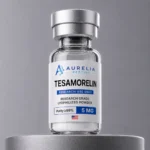
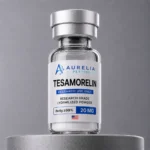
Tesamorelin
A stabilized GHRH(1-44) analog studied in pituitary GH signaling and visceral-adipose biology
- Fulfillment Origin
- us
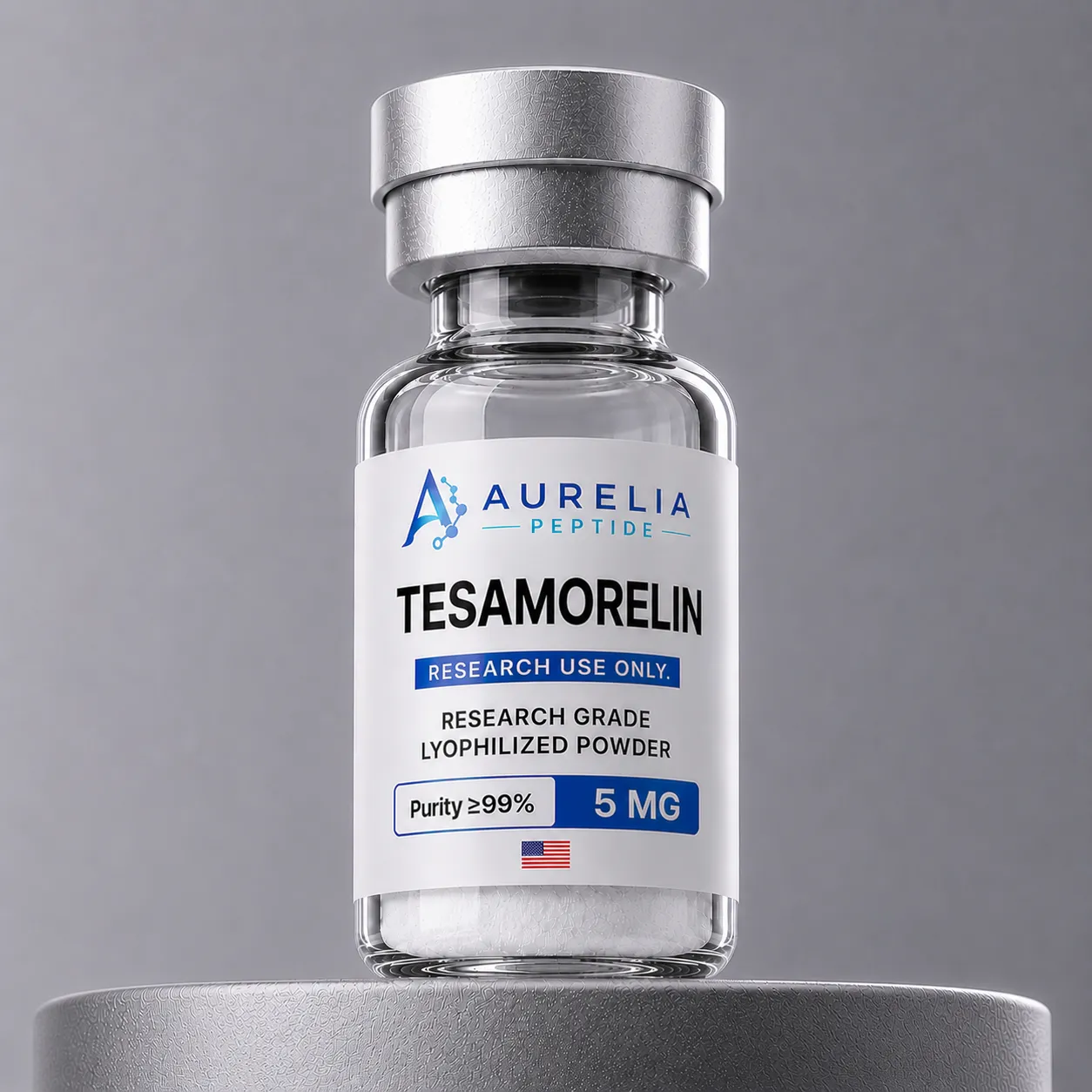
Tesamorelin is a synthetic 44-amino-acid analog of human growth hormone-releasing hormone with an N-terminal trans-3-hexenoyl modification. It activates pituitary GHRH receptors and increases endogenous growth-hormone and downstream IGF-1 signaling. The prescription product Egrifta is FDA approved for reduction of excess abdominal fat in adults with HIV and lipodystrophy; research-grade material sold here is not that approved pharmaceutical product.
Trans-3-hexenoyl-modified GHRH(1-44) amide analog
- Formula
- C221H366N72O67S
- Molecular weight
- Approximately 5136 g/mol
- Form
- Lyophilized powder
- CAS / ID
- 218949-48-5
Independently tested. Verifiably pure.
Every batch of Tesamorelin is reviewed against its independent laboratory documentation before fulfillment.
- HPLC Purity AnalysisReported purity: Lot-specific purity — see COA
- Mass SpectrometryMass spectrometry — see lot COA
- Heavy Metals ScreeningLot-specific result — see COA
- Endotoxins (LPS)Lot-specific result — see COA
- Sterility TestingLot-specific result — see COA
- Net Peptide ContentLot-specific result — see COA
- HPLC Purity
- Lot-specific purity — see COA
- Identity
- Mass spectrometry — see lot COA
- Endotoxin (LAL)
- Lot-specific result — see COA
- Lab
- Independent third-party laboratory
Not for human or veterinary use. For in-vitro laboratory research only. This product is not intended to diagnose, treat, cure, or prevent any disease.
Full-length GHRH signaling. Stabilized at the N-terminus.
Tesamorelin preserves the 44-residue GHRH signaling sequence while adding a trans-3-hexenoyl group at the N-terminus. It has been studied as a selective pituitary GHRH-receptor agonist that augments endogenous pulsatile GH release and downstream IGF-1.
Modified GHRH(1-44)
A full-length human GHRH analog with an N-terminal stability modification.
GHRH receptor agonist
Acts at pituitary GHRH receptors rather than serving as exogenous growth hormone.
GH and IGF-1 signaling
Clinical pharmacology studies document increased endogenous GH secretion and circulating IGF-1.
The Tesamorelin molecule
An interactive illustrative atomic representation paired with verified public compound data. The structure graphic is schematic and is not a measured solution conformation.
Published clinical research observations.
Selected outcomes concern pharmaceutical tesamorelin studied under controlled clinical protocols, primarily in adults with HIV-associated lipodystrophy. They do not establish equivalence, efficacy or safety for this commercial research material.
Controlled clinical period
Major trials evaluated visceral adipose tissue after approximately six months of treatment.
Visceral adipose change reported
A 2007 randomized trial reported a 15.2% mean decrease versus a 5.0% increase with placebo.
Maintenance depended on treatment
A subsequent trial reported loss of VAT improvement after participants switched from tesamorelin to placebo.
One receptor axis. Endogenous pulsatile signaling.
Tesamorelin acts through the hypothalamic-pituitary growth-hormone axis rather than replacing GH directly. Downstream effects depend on the physiologic and clinical context.
Pituitary receptor agonism
Tesamorelin binds the growth hormone-releasing hormone receptor on pituitary somatotroph cells.
Endogenous GH release
Clinical physiology research reports augmentation of basal and pulsatile growth-hormone secretion.
Downstream endocrine signaling
Increased GH signaling raises circulating IGF-1, an important monitored pharmacodynamic response.
Where Tesamorelin fits.
This comparison separates a full-length GHRH analog from shorter GH secretagogues and from exogenous GH. It is not a recommendation or clinical-equivalence table.
Tesamorelin
A stabilized 44-residue GHRH-receptor agonist with an approved pharmaceutical counterpart.
Sermorelin
A shorter GHRH(1-29) analog with a different sequence length and regulatory history.
Ipamorelin
A ghrelin-receptor secretagogue rather than a GHRH-receptor agonist.
| Research molecule | Primary target | Peptide design | Signal |
|---|---|---|---|
| Tesamorelin | GHRH receptor | Modified GHRH(1-44) | Endogenous GH → IGF-1 |
| Sermorelin | GHRH receptor | GHRH(1-29) | Endogenous GH → IGF-1 |
| Ipamorelin | GHS-R1a | Pentapeptide secretagogue | GH secretagogue pathway |
GHRH-axis activity visualized.
Qualitative bars summarize the established signaling hierarchy and are not comparative binding-potency or dose-response measurements.
Stabilized GHRH(1-44) peptide design.
The N-terminal trans-3-hexenoyl modification distinguishes tesamorelin from native GHRH. Pharmaceutical pharmacokinetics depend on formulation and administration and must not be assumed for an unverified research lot.
Full-length analog
Retains the 44-residue GHRH signaling sequence.
Trans-3-hexenoyl modification
The N-terminal modification increases stability compared with native GHRH.
Large peptide analog
Approximate molecular weight in grams per mole for tesamorelin.
Full specification.
Public active-moiety identity is shown separately from lot-specific acetate, water, purity, identity and net-peptide measurements.
Trans-3-hexenoyl-GRF(1-44)-NH2
N-terminally modified growth hormone-releasing factor analog.
C221H366N72O67S
Public tesamorelin active-moiety formula.
Approximately 5136 g/mol
Public compound-record molecular weight.
Modified GHRH(1-44)
Forty-four amino acids with an N-terminal trans-3-hexenoyl group.
218949-48-5
PubChem CID 16137828.
See selected COA
Purity, identity, acetate, water, endotoxin and net content are lot-specific.
Tesamorelin research and regulatory timeline.
Selected milestones distinguish peer-reviewed clinical research and the approved pharmaceutical product from research-grade material.
Visceral and liver-fat trial published
A randomized clinical trial evaluated visceral adipose tissue and hepatic fat in adults with HIV-associated abdominal fat accumulation.
Twelve-month extension published
Controlled research examined maintenance and reversal of visceral-adipose changes over an extension period.
Egrifta received FDA approval
The prescription product was approved for reduction of excess abdominal fat in adults with HIV and lipodystrophy.
Phase III results published
A randomized trial reported changes in visceral adipose tissue, triglycerides, IGF-1 and body-image measures.
Handling and documentation.
Storage and prepared-material stability depend on the exact formulation, acetate content, container, concentration and lot. Follow the product label and supplier-validated documentation rather than another seller's instructions.
Follow documented storage
Keep lyophilized material within the conditions stated by the verified supplier documentation.
Minimize exposure
Keep the container closed and use appropriate laboratory monitoring and handling.
Use validated stability data
Stability depends on solvent, pH, concentration, container, temperature and handling.
- Check the lot recordMatch the vial identifier with its available Certificate of Analysis.
- Confirm material formIdentify the documented active moiety, acetate basis and net peptide content.
- Use a validated methodHandle laboratory material using qualified equipment and an approved protocol.
- Record handlingDocument lot, solvent, concentration, container, conditions and disposition.
Featured Tesamorelin research.
Selected regulatory compound data and peer-reviewed clinical studies are provided for scientific context. Results from approved pharmaceutical tesamorelin do not verify a commercial research lot.
Public molecular formula, molecular weight, identifiers and compound description.
View primary source →A randomized 26-week trial evaluated visceral adipose tissue, triglycerides, IGF-1, body image and glycemic measures.
View primary source →A randomized placebo-controlled trial with a safety extension examined VAT and body-composition outcomes through 12 months.
View primary source →A randomized clinical trial examined CT-measured visceral adipose tissue and magnetic-resonance-measured hepatic fat.
View primary source →A physiology study evaluated basal and pulsatile GH secretion, IGF-1 and insulin-stimulated glucose uptake.
View primary source →A clinical review summarized Phase III efficacy, extensions, regulatory status and limitations.
View primary source →References.
Government compound data and peer-reviewed clinical publications used for this dossier.
- PubChem. Tesamorelin, CID 16137828.Open source ↗
- Grunfeld C, et al. Metabolic effects of a growth hormone-releasing factor in patients with HIV. New England Journal of Medicine. 2007.Open source ↗
- Falutz J, et al. Effects of tesamorelin in HIV-infected patients with abdominal fat accumulation. Journal of Acquired Immune Deficiency Syndromes. 2010.Open source ↗
- Stanley TL, et al. Effect of tesamorelin on visceral fat and liver fat in HIV-infected patients. JAMA. 2014.Open source ↗
- Stanley TL, et al. Effects of a growth hormone-releasing hormone analog on endogenous GH pulsatility and insulin sensitivity. 2010.Open source ↗
- Mulligan K, et al. Tesamorelin: a growth hormone-releasing factor analogue for HIV-associated lipodystrophy. 2012.Open source ↗
Related products
CJC / IPA Blend
CJC-1295 Whit DAC
IGF-1 LR3
Ipamorelin
Sermorelin