
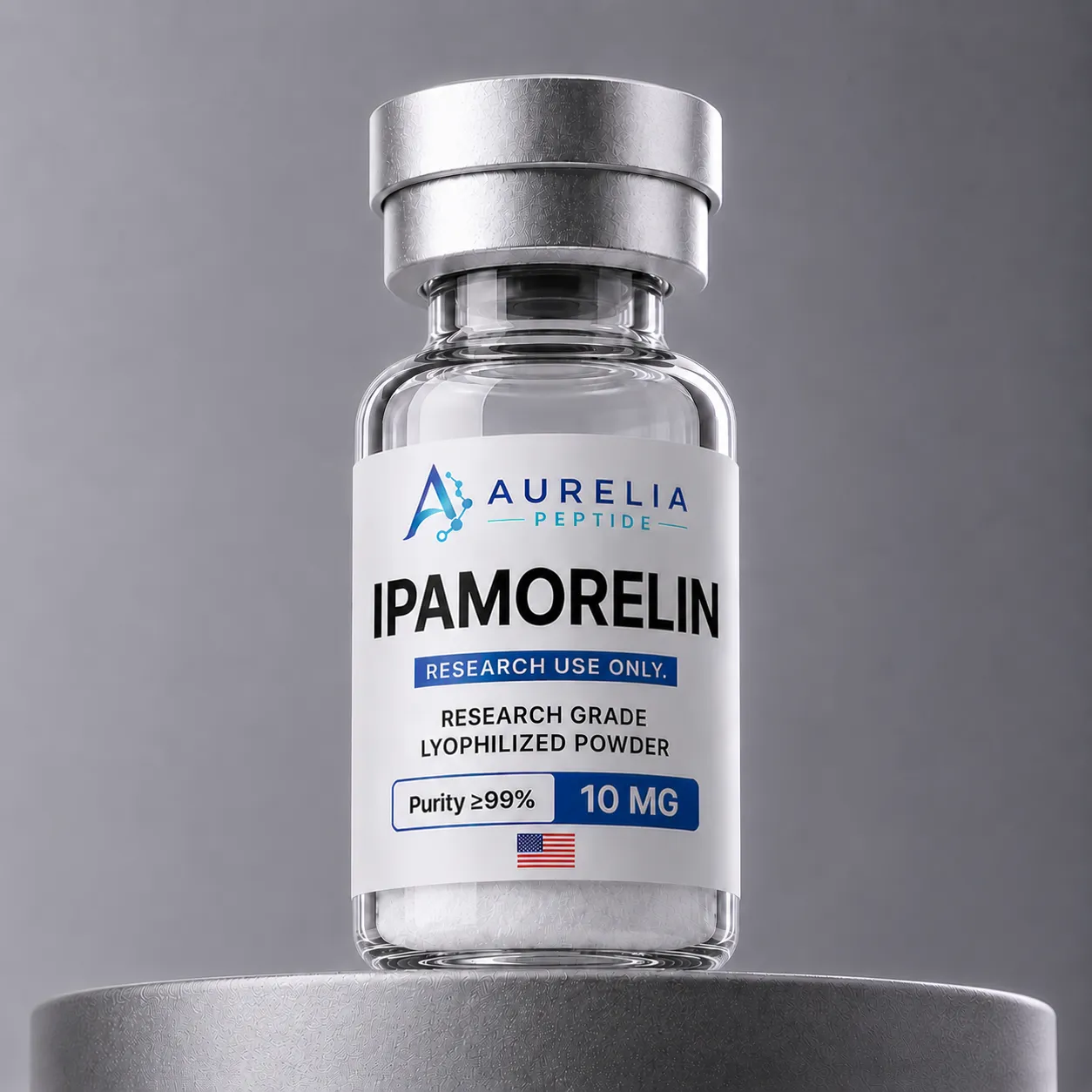
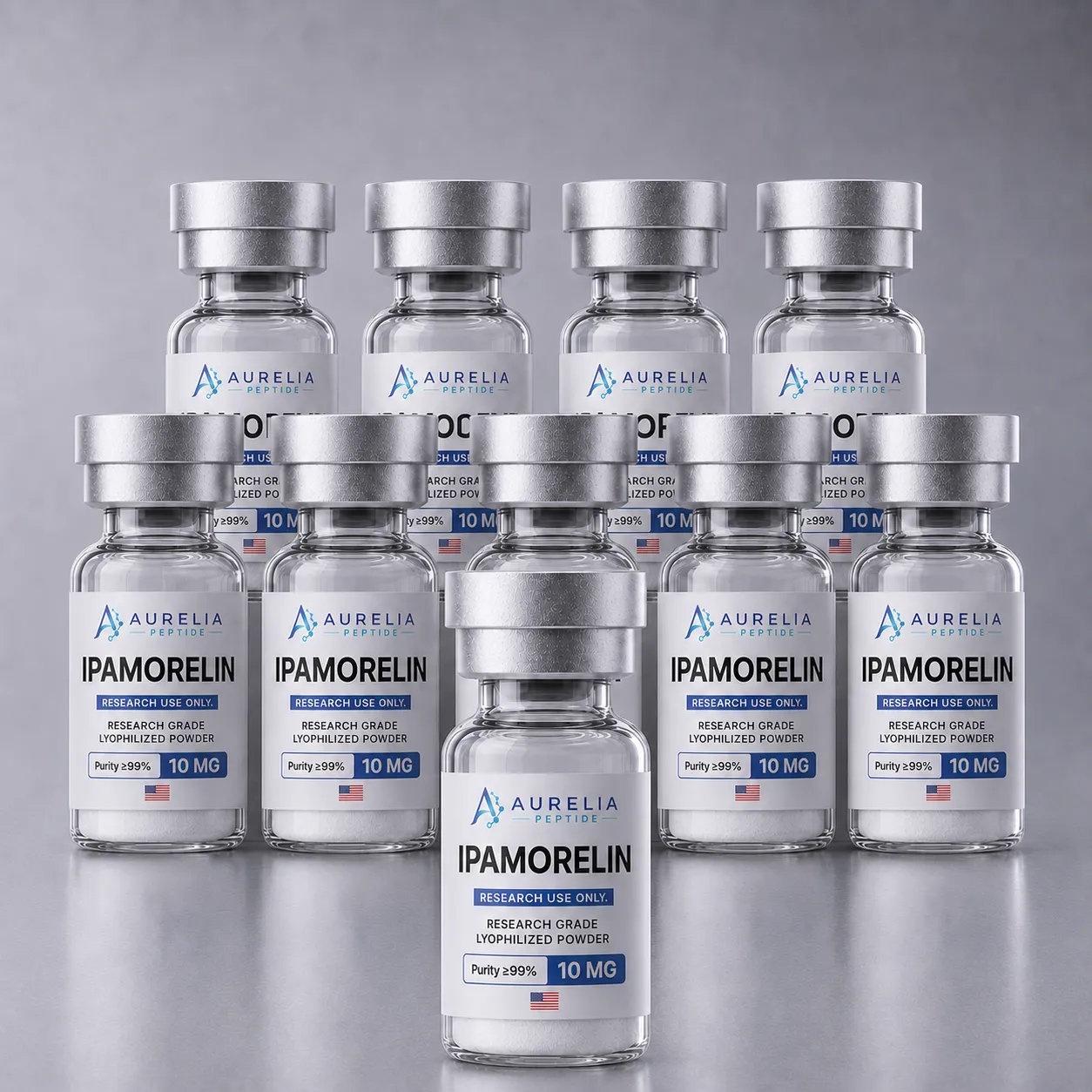
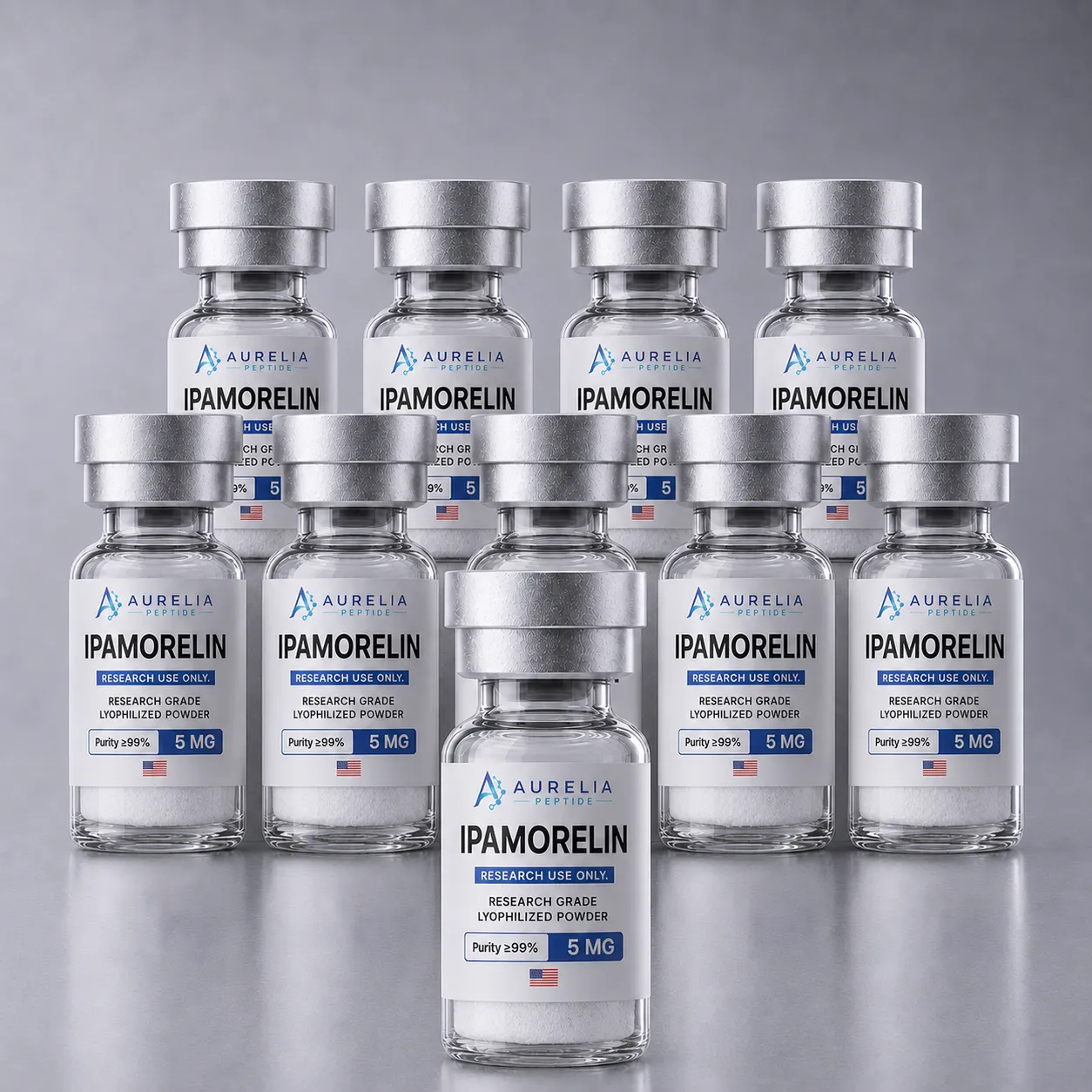
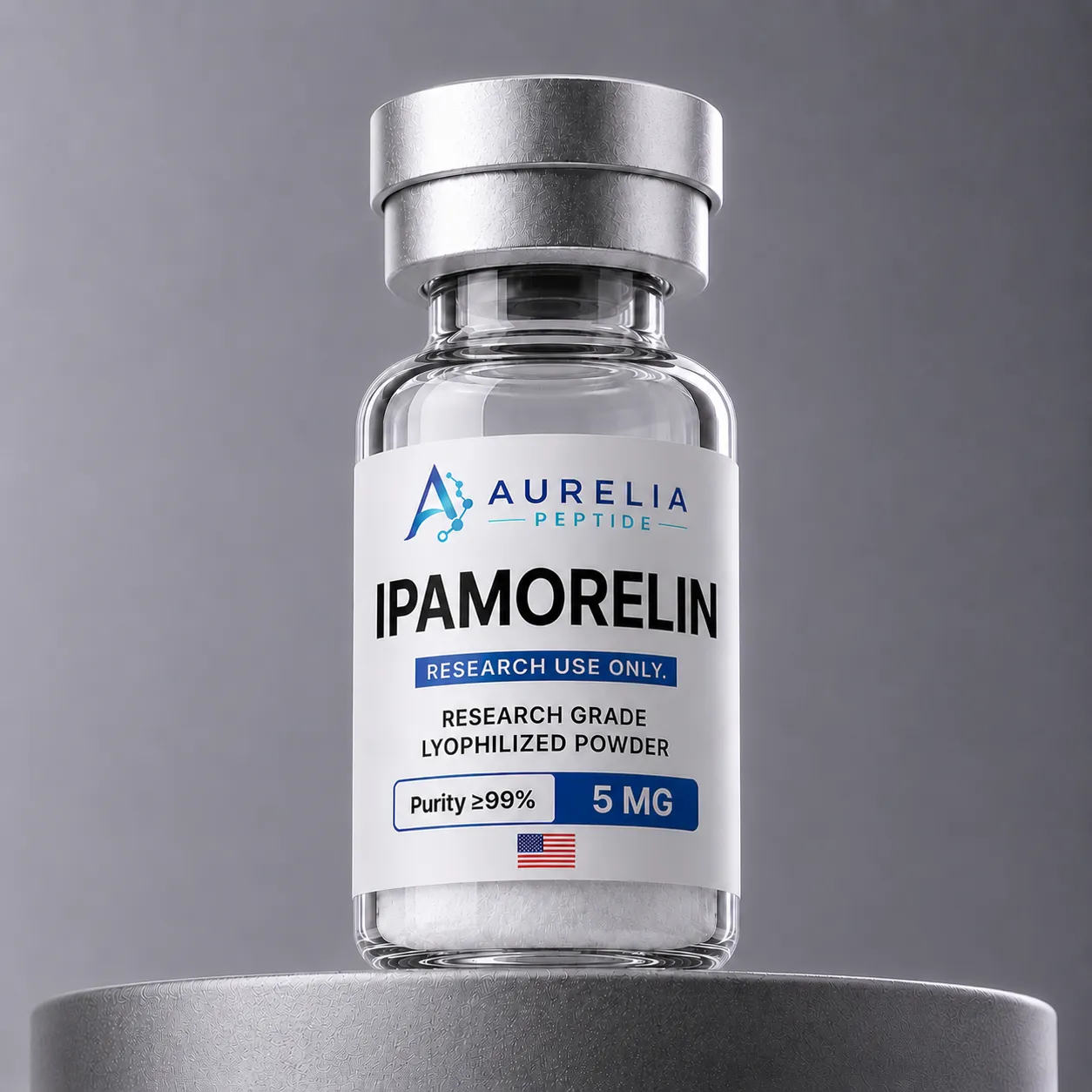
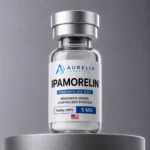
Ipamorelin
A selective pentapeptide growth-hormone secretagogue studied for GHSR-1a signaling
- Fulfillment Origin
- us
Ipamorelin is a synthetic pentapeptide growth-hormone secretagogue that activates the growth hormone secretagogue receptor type 1a, also known as the ghrelin receptor. Research commonly examines pituitary growth-hormone release, pulsatile endocrine signaling, downstream IGF-1 biology and its comparatively selective profile versus earlier GHRP compounds.
Pentapeptide GH secretagogue · GHSR-1a agonist
- Formula
- C38H49N9O5
- Molecular weight
- 711.85 g/mol
- Form
- Lyophilized powder
- CAS / ID
- 170851-70-4
Independently tested. Verifiably pure.
Every batch of Ipamorelin is reviewed against its independent laboratory documentation before fulfillment.
- HPLC Purity AnalysisReported purity: Lot-specific purity — see COA
- Mass SpectrometryMass-spectrometric identity — see lot COA
- Heavy Metals ScreeningLot-specific result — see COA
- Endotoxins (LPS)Lot-specific result — see COA
- Sterility TestingLot-specific result — see COA
- Net Peptide ContentLot-specific result — see COA
- HPLC Purity
- Lot-specific purity — see COA
- Identity
- Mass-spectrometric identity — see lot COA
- Endotoxin (LAL)
- Lot-specific result — see COA
- Lab
- Independent third-party laboratory
Not for human or veterinary use. For in-vitro laboratory research only. This product is not intended to diagnose, treat, cure, or prevent any disease.
A five-residue secretagogue engineered for selective GH-axis research.
Ipamorelin is a compact synthetic pentapeptide with the sequence Aib-His-D-2-Nal-D-Phe-Lys-NH₂. Its non-natural residues and C-terminal amide support receptor activity and distinguish it from endogenous ghrelin.
Synthetic pentapeptide
A five-residue growth-hormone secretagogue containing non-proteinogenic amino-acid components.
GHSR-1a
Activates the growth hormone secretagogue receptor expressed in pituitary and hypothalamic signaling systems.
Selective GH secretion
Frequently studied as a tool for examining GH release with less ACTH, cortisol and prolactin recruitment than older GHRPs.
The Ipamorelin molecule visualized.
The animated structure represents its five-residue peptide backbone, non-natural side chains and terminal amide.
Published research areas associated with Ipamorelin.
The summaries below describe preclinical and endocrine research themes and are not directions for administration or clinical use.
Ghrelin-receptor agonism
Ipamorelin is used to study selective activation of the growth hormone secretagogue receptor.
Dose-dependent secretion
Preclinical work has examined concentration-dependent growth-hormone release and pulse characteristics.
Reduced ACTH, cortisol and prolactin recruitment
Published comparisons describe a cleaner endocrine profile than several earlier GHRP compounds.
Ipamorelin signaling pathways visualized.
The animated pathway map follows GHSR-1a activation through pituitary signaling, growth-hormone release and downstream IGF-1 biology.
Growth hormone secretagogue receptor activation
Ipamorelin binds GHSR-1a on pituitary somatotrophs and initiates receptor-dependent signaling.
Secretory signal recruitment
GHSR-1a signaling can engage phospholipase pathways and intracellular calcium mobilization.
Pulsatile growth-hormone release
The activated somatotroph releases endogenous GH in a pulse-like endocrine response.
Downstream somatotropic signaling
Pituitary GH can stimulate hepatic IGF-1 production and related downstream pathways.
Ipamorelin compared with earlier GHRP compounds.
Ipamorelin, GHRP-2 and GHRP-6 share GHSR-1a activity, but differ in endocrine selectivity and appetite-related signaling.
Selective GH secretagogue
Designed to stimulate GH release with limited ACTH, cortisol and prolactin elevation in comparative research.
Broader pituitary activation
Can produce robust GH release while also recruiting additional endocrine outputs.
GH and appetite signaling
Known for strong GHSR activity and more prominent orexigenic effects in research models.
| Compound | Primary receptor | GH release | Comparative research profile |
|---|---|---|---|
| Ipamorelin | GHSR-1a | Dose-dependent | Greater endocrine selectivity |
| GHRP-2 | GHSR-1a | Strong | More ACTH/cortisol recruitment |
| GHRP-6 | GHSR-1a | Strong | More appetite-related signaling |
Endocrine selectivity visualized.
These bars summarize the published comparative profile and are not universal quantitative binding-affinity measurements.
Short direct exposure with a longer endocrine response window.
Published discussions commonly describe rapid peptide clearance and a growth-hormone response that peaks after administration and persists beyond the period of highest circulating peptide concentration. Exact values depend on study design, assay and species.
Rapid-clearance secretagogue
The commonly cited value should be treated as study-dependent rather than universal.
Prompt pituitary output
Published human research has described an early peak in growth-hormone response.
Use analytical documentation
Identity, purity and net peptide content should be verified using the actual Aurelia lot COA.
Full specification.
The fields below describe compound identity. Final analytical values must match the actual Aurelia lot documentation.
Ipamorelin
Synthetic pentapeptide growth-hormone secretagogue.
GHSR-1a agonist
A ghrelin-receptor-active secretagogue.
Aib-His-D-2-Nal-D-Phe-Lys-NH₂
Five-residue peptide with a C-terminal amide.
5 residues
Classified as a pentapeptide.
C38H49N9O5
Elemental composition of Ipamorelin.
711.85 g/mol
Calculated molecular mass.
170851-70-4
Common Ipamorelin identifier.
See lot COA
Confirm identity, purity, net content, sterility and endotoxin results.
From GHSR-1a binding to downstream endocrine signaling.
This is an illustrative mechanistic sequence, not a dosing or treatment timeline.
GHSR-1a binding
Ipamorelin engages the growth hormone secretagogue receptor on pituitary somatotrophs.
Intracellular calcium signaling
Receptor activation recruits secretory signaling pathways that support vesicular hormone release.
Growth-hormone pulse
Endogenous GH is released into the experimental system.
IGF-1 and feedback response
Downstream hepatic signaling and endocrine feedback shape the overall response.
Handle as a sensitive research peptide.
Use the storage conditions validated for the actual Aurelia lot and document all preparation and hold-time variables.
Cold, dry and protected
Protect from moisture, direct light, excessive heat and repeated temperature cycling.
Solution stability is conditional
Stability depends on solvent, pH, concentration, container, temperature and contamination control.
Avoid repeated freeze-thaw events
Aliquoting and validated low-binding containers may reduce degradation and adsorption.
- Record the lotLink every experiment to the vial identifier and corresponding COA.
- Follow validated storageUse the temperature range stated on the Aurelia label and lot documentation.
- Minimize agitationHandle gently to reduce foaming, adsorption and peptide degradation.
- Document preparationRecord solvent, concentration, pH, container, temperature and elapsed hold time.
For in-vitro laboratory research only. Not for human or veterinary use.
Ipamorelin literature library.
The publications below provide context for selective GH secretion, sleep-associated endocrine release and GHSR biology.
Foundational preclinical work describing dose-dependent GH release and a comparatively selective endocrine profile.
View primary source →Human research examining GH secretagogue activity across early nocturnal sleep phases.
View primary source →Research context for ghrelin biology and the GHSR signaling system.
View primary source →Comparative research on GH output and additional pituitary-adrenal responses among secretagogues.
View primary source →References.
Independent literature supporting the molecular and mechanistic context used in this dossier.
- Raun K et al. Ipamorelin, the first selective growth hormone secretagogue. European Journal of Endocrinology. 1998.Open source ↗
- Frieboes RM et al. Growth hormone-releasing peptides stimulate GH secretion in human subjects during nocturnal sleep. 2004.Open source ↗
- Kojima M, Kangawa K et al. Ghrelin and growth hormone secretagogue receptors: functional characterization. 2001.Open source ↗
- Arvat E et al. Comparative endocrine responses to GHRP-class secretagogues. 2000.Open source ↗
Related products
CJC / IPA Blend
CJC-1295 Whit DAC
IGF-1 LR3
Sermorelin
TESA / IPA Blend