
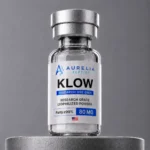
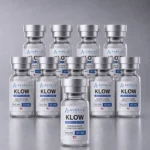
KLOW Blend
A four-component peptide formulation for matrix, migration, epithelial and inflammatory-signaling research
- Fulfillment Origin
- us
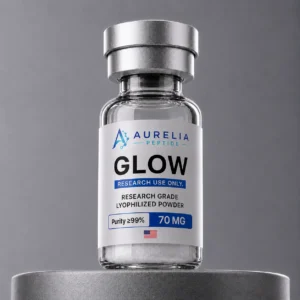
KLOW Blend combines GHK-Cu, a supplier-defined TB-500 material, BPC-157 and KPV in one lyophilized formulation. Each component has a distinct molecular identity and an independent research literature. The mixture is therefore described as a formulation rather than a new molecule, and evidence for an individual component does not establish synergy, safety or efficacy for the combination.
GHK-Cu 50 mg + TB-500 10 mg + BPC-157 10 mg + KPV 10 mg
- Formula
- Mixture — no single molecular formula
- Molecular weight
- Not applicable to a mixture
- Form
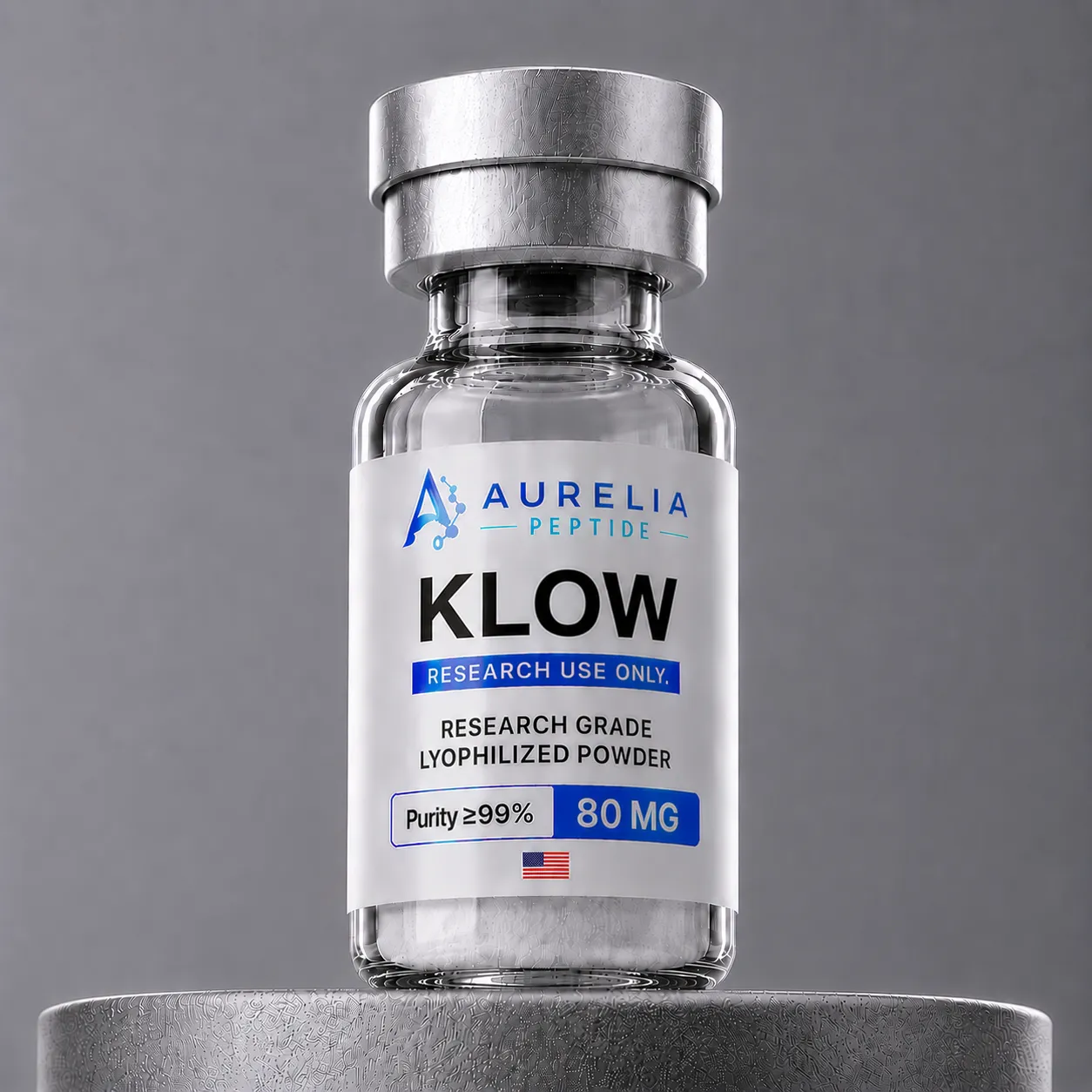
- Lyophilized powder (80 mg total nominal content)
- CAS / ID
- Mixture — component-specific identifiers
Independently tested. Verifiably pure.
Every batch of KLOW Blend is reviewed against its independent laboratory documentation before fulfillment.
- HPLC Purity AnalysisReported purity: Component-specific results — see lot COA
- Mass SpectrometryFour-component identity — see lot COA
- Heavy Metals ScreeningLot-specific result — see COA
- Endotoxins (LPS)Lot-specific result — see COA
- Sterility TestingLot-specific result — see COA
- Net Peptide Content80 mg nominal total — verify lot COA
- HPLC Purity
- Component-specific results — see lot COA
- Identity
- Four-component identity — see lot COA
- Endotoxin (LAL)
- Lot-specific result — see COA
- Lab
- Independent third-party laboratory
Not for human or veterinary use. For in-vitro laboratory research only. This product is not intended to diagnose, treat, cure, or prevent any disease.
Four components. Four independent research profiles.
KLOW is a multi-peptide formulation, not a covalently linked molecule. GHK-Cu contributes a copper-coordinating tripeptide complex; TB-500 is a supplier-defined thymosin-beta-4-related material; BPC-157 is a synthetic pentadecapeptide; and KPV is the Lys-Pro-Val tripeptide.
50 + 10 + 10 + 10 mg
The stated 80 mg total is distributed among four separately identifiable components.
Component-level literature
Published findings belong to the individual molecules or related thymosin-beta-4 research, not automatically to the commercial mixture.
Verify every component
A useful lot record should distinguish component identity and quantity instead of reporting only one blanket blend-purity value.
The KLOW Blend components
An animated representative component network is shown because this formulation has no single molecular structure. The copper-colored node denotes the copper complex in GHK-Cu; the remaining network is illustrative and is not a measured conformation.
Published research observations.
The research landscape spans peptide-copper biology, thymosin-beta-4-related migration, preclinical BPC-157 models and KPV transport and inflammatory signaling. Controlled studies have not established that combining these materials creates additive or synergistic outcomes.
Separately identifiable components
Each requires its own identity and content evidence in lot documentation.
Total material per vial
GHK-Cu accounts for 50 mg; each remaining component accounts for 10 mg.
Mostly component-level research
Published component observations should not be presented as validated performance of this four-way blend.
Four research contexts. One formulation.
The formulation places distinct materials together, but it does not merge their mechanisms into one confirmed pathway.
Copper coordination and extracellular-matrix research
GHK-Cu has been investigated in fibroblast, collagen, extracellular-matrix and tissue-remodeling contexts.
Migration and preclinical repair models
Thymosin beta-4 literature addresses actin-associated cell migration, while BPC-157 research is predominantly preclinical and includes tendon and vascular-response models.
Epithelial transport and inflammatory signaling
KPV has been studied as a PepT1-transported tripeptide in intestinal cellular and animal inflammation models.
Where KLOW Blend fits.
This comparison organizes formulation types by included components. It does not compare clinical effectiveness, safety or suitability.
KLOW Blend
GHK-Cu, supplier-defined TB-500, BPC-157 and KPV.
Matrix / migration blend
A blend containing GHK-Cu, a thymosin-related material and BPC-157, without KPV.
Individual research material
One molecular identity, allowing simpler identity, purity and content reporting.
| Formulation | GHK-Cu | TB-500 | BPC-157 | KPV |
|---|---|---|---|---|
| KLOW Blend | Included | Included | Included | Included |
| Three-component blend | Included | Included | Included | — |
| Single-component vial | One selected component | — | — | — |
Composition visualized.
Bars show nominal mass allocation in the 80 mg formulation. They do not represent biological potency, receptor selectivity or expected effect.
A mixture, not one pharmacokinetic entity.
The four components differ in size, chemical form, degradation and biological disposition. Reporting one half-life or one exposure curve for the blend would be scientifically inappropriate without formulation-specific measurements.
Independent constituents
Each component retains its own chemical and analytical identity.
No single valid value
Component literature cannot be combined into a blend-wide half-life.
Formulation-specific data required
Any stability or exposure claim should be supported by data generated for the actual formulation.
Full formulation specification.
The following values describe the stated nominal composition. Release documentation should confirm identity and quantity for each named component in the actual lot.
Component research, most recent context first.
These milestones concern individual components or related parent molecules. They are not a clinical-development timeline for KLOW Blend.
Orally targeted KPV delivery investigated
A hyaluronic-acid-based delivery study examined KPV in experimental colitis models.
BPC-157 tendon-cell signaling study
A preclinical study reported growth-hormone-receptor-related effects in tendon fibroblasts.
PepT1-mediated KPV uptake reported
Cellular and animal work linked intestinal PepT1 transport with reduced inflammatory readouts.
Thymosin beta-4 migration research
Human endothelial-cell experiments reported directional migration associated with thymosin beta-4.
Stability is formulation- and lot-specific.
Because KLOW contains four distinct materials, storage, reconstitution and prepared-solution behavior must be supported by documentation generated for the actual formulation.
Use documented conditions
Rely on supplier-validated formulation data rather than another seller's generic specifications.
No assumed common window
A single-component prepared-solution period cannot be assigned automatically to this mixture.
Lot-specific criteria
Identity, quantity, purity and other release tests should be evaluated against the actual specification.
- Verify the lotMatch the vial identifier with a COA that names and quantifies all four components.
- Follow validated storageUse the temperature, light and moisture conditions documented by the manufacturer or testing program.
- Protect formulation identityAvoid assigning single-component stability data to the four-way mixture.
- Record handlingDocument lot, container, date, conditions and disposition for laboratory traceability.
Research on the KLOW components.
Selected publications provide context for individual constituents or related parent molecules. They do not validate the KLOW combination as a therapeutic product.
A fibroblast-focused study examining collagen synthesis associated with the GHK-copper complex.
View primary source →In vitro and migration-model research on thymosin beta-4 and endothelial-cell movement.
View primary source →Preclinical rat and in-vitro tendocyte research; not evidence of human clinical efficacy.
View primary source →Cellular and animal research on KPV transport and inflammatory readouts.
View primary source →Experimental delivery research in colitis models.
View primary source →References
Primary publications and public records used to characterize the individual components and the limits of blend-level interpretation.
- Maquart FX, et al. Stimulation of collagen synthesis in fibroblast cultures by the tripeptide-copper complex glycyl-L-histidyl-L-lysine-Cu2+. FEBS Lett. 1988.Open source ↗
- Malinda KM, et al. Thymosin beta 4 stimulates directional migration of human umbilical vein endothelial cells. FASEB J. 1997.Open source ↗
- Staresinic M, et al. Gastric pentadecapeptide BPC 157 accelerates healing of transected rat Achilles tendon and in vitro stimulates tendocytes growth. J Orthop Res. 2003.Open source ↗
- Dalmasso G, et al. PepT1-mediated tripeptide KPV uptake reduces intestinal inflammation. Gastroenterology. 2008.Open source ↗
- Xiao B, et al. Orally targeted delivery of tripeptide KPV via hyaluronic acid-functionalized nanoparticles in experimental colitis. J Control Release. 2017.Open source ↗
Related products
ARA-290
BPC-157
Glow